
What Is the Wahl-O-Mat?
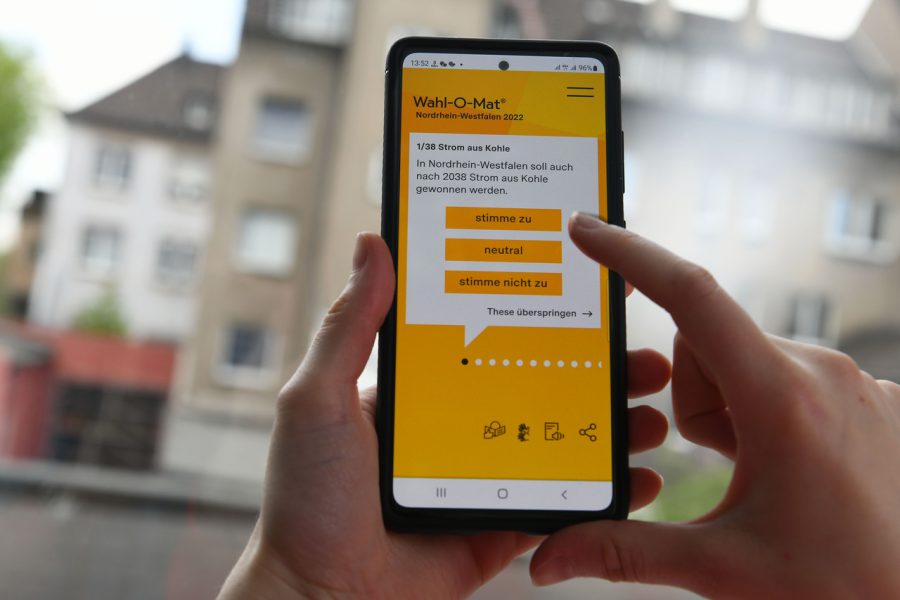
The Wahl-O-Mat has been provided by the Federal Agency for Civic Education (Bundeszentrale für politische Bildung, bpb) since 2002. It is an online voting advice tool that allows users to compare their own political positions with those of political parties in Germany.
Anyone using the Wahl-O-Mat can respond to a series of political statements. One example from previous years is: “The state should provide all pupils with free digital devices.” Users then decide whether they agree, disagree, take a neutral stance, or wish to skip the statement. There are 38 political statements in total. After answering all of them, users can weight individual topics differently. This means, for example: Is climate protection more important to you than digitalisation? Or is foreign policy more important than domestic policy?
The political parties approved to stand in the election have already answered these statements in advance. Based on their answers, users are shown which party has the greatest overlap with their own views. The Wahl-O-Mat is available for state, federal, and European Parliament elections.
However, the Wahl-O-Mat has also faced criticism. Parties can only express their positions on the statements that have been included. Critics repeatedly argue that this oversimplifies or distorts the parties’ positions. Others criticise the fact that certain topics, such as culture, are underrepresented in the Wahl-O-Mat. In recent years, alternatives have also emerged, such as the “Real-O-Mat.” It examines whether parties’ political proposals can realistically be implemented.
What Does Media Literacy Mean?
The German term Medienkompetenz, usually translated as media literacy, refers first of all to the ability to use media safely. But it also means using media critically, creatively and responsibly. The aim is therefore not simply to consume media, but to engage with it in a reflective way.
Before people can analyse media content or evaluate it critically, they first need basic knowledge. This means understanding how the German media system works (private and public-service media, financing). People should also be familiar with the different types of media available.
From an educational perspective, promoting media literacy means teaching people about media and how to use it. This is usually aimed at people who have so far made little independent use of media and are therefore not yet able to use it confidently or critically. For this reason, media literacy training is increasingly being offered in schools.
From a technical perspective, media literacy also includes being able to operate devices or software independently. Here too, support services are available for people who do not yet have these skills.
What Is the Difference Between Disinformation, Misinformation, and Fake News?
Disinformation, misinformation, and fake news are often treated as if they were the same thing. They have similarities, but they are not identical.
Disinformation is information that is deliberately false or deliberately spread in a misleading way. It is published with the intention of harming a particular person, group, or even a country. Disinformation becomes especially common during times of crisis or before elections.
However, it is important to remember that disinformation can take many different forms. It may appear as an online article that supposedly comes from a trustworthy news outlet. Or it may be shared as a message, photograph, or video via messaging services and social media. Such content is often highly creative and emotional in order to appeal to as many people as possible.
The term ‘fake news’ is now primarily used as a political buzzword. It gives the impression of being genuine, trustworthy news. However, fake news is deliberately spread and is usually politically motivated. It can often be recognised by sensational headlines and manipulated images. In many cases, the purpose is also to generate revenue through large numbers of clicks.
Misinformation, on the other hand, refers to false information that was not created or shared with deliberate intent to deceive. It is therefore the result of a mistake—for example, an error during research or a misinterpretation of information. When misinformation has been published, it is often followed by a correction or an explanatory note.
Here you can find the Berlin Wiki page of Berliner Morgenpost.
(Header image: © FUNKE Foto Services | Oliver Müller)