
StimmlosTrend 2026: 96 Percent Would Vote If They Could

WahlheYmatPost,

The final results of WahlheYmat’s StimmlosTrend are in. They show a striking willingness to participate among international Berliners without voting rights – but also widespread concern about the city’s future and a strong sense of having little influence over it.

Around one million people living in Berlin do not hold a German passport, 851,000 of whom are adults. They cannot vote in elections to the Berlin House of Representatives – and their political views are therefore largely absent from traditional election polling.

WahlheYmat created StimmlosTrend 2026 to make these perspectives visible. Inspired by the BerlinTrend conducted by Infratest dimap, the survey uses several of the same questions to explore how international Berliners see the city, what they consider its most pressing problems and how much influence they feel they have over Berlin’s future.

The results were first published by our media partner, Berliner Morgenpost. They point to a clear message: the lack of voting rights does not mean a lack of willingness to participate.

Among respondents who answered the voting question, 90.8 percent said they would vote if they were allowed to. Another 5.2 percent said they would do so under certain circumstances. Together, this means that 96 percent could potentially vote if given the opportunity.

At the same time, many respondents feel disconnected from the decisions shaping the city in which they live. 72.4 percent are somewhat or very concerned about Berlin’s future, while 73.9 percent feel they have little or no influence over it.

For 55.5 percent, these two feelings come together: they are worried about where Berlin is heading and at the same time feel they have little power to change that direction.

“The results show very clearly: Not having the right to vote does not mean that people have no political interest or do not feel responsible for Berlin. On the contrary. Many want to help shape the city, but feel that their own opportunities to do so are limited,” says Esther Nass, Project Manager of StimmlosTrend at WahlheYmat e.V.

Housing dominates the political agenda

When respondents were asked, without being given a list of options, to name Berlin’s most important political problems, one issue stood out clearly: housing and rents.

50.7 percent named housing and rents as Berlin’s single most important political problem. When first and second mentions are combined, the figure rises to 63.6 percent.

Other issues follow at a considerable distance. The shift to the right, racism and discrimination were mentioned in first or second place by 14.3 percent of respondents, homelessness and drugs by 14.1 percent, and transport and mobility by 13.9 percent.

There is an interesting parallel with Berliners who are eligible to vote. In the current BerlinTrend, housing and rents are also the most frequently mentioned political problem, at 32 percent.

This comparison is one of the ideas behind StimmlosTrend. By using several core BerlinTrend questions with identical wording, the project makes it possible to place the perspectives of people without voting rights alongside those of eligible voters.

A similarly critical view of the Berlin Senate

The two groups also come surprisingly close in their assessment of Berlin’s state government.

Only 15.8 percent of StimmlosTrend respondents say they are satisfied or very satisfied with the work of the Berlin Senate. Among eligible voters surveyed in the September BerlinTrend, the figure is 19 percent.

In other words, both groups take a similarly critical view of the Senate – but only one of them can vote on the composition of the Berlin House of Representatives on 20 September.

Engaged, even without a vote

Not having a vote does not mean not participating in society. More than half of respondents (52.4 percent) say they are engaged through family and friends, while 33.3 percent are active in clubs, volunteering or welfare organisations and 31.6 percent in their neighbourhood or Kiez.

Another 18.1 percent are engaged through work or trade unions, and 7.1 percent through political parties. Only 23.1 percent selected “none of the above.”

German skills and engagement linked to a stronger sense of influence

The results also provide an insight into what is associated with people feeling able to influence the city around them.

Among respondents with limited or no German language skills who are not socially engaged, only 6.1 percent say they have a strong influence on Berlin’s future.

Among those with good or very good German language skills who are also socially engaged, that figure rises to 32.9 percent – more than five times as high.

The data therefore show a clear association between German language skills, social engagement and perceived influence. They do not, however, establish what causes this relationship. And even among those who speak good German and are actively engaged, concern about Berlin’s future remains high.

A snapshot

StimmlosTrend was conducted as an open online survey from 11 July to 8 September 2026 and was available in eight languages.

The survey is not representative and its results cannot be extrapolated to all Berliners without voting rights. Participation was voluntary, and the sample is particularly skewed in terms of education: 90.3 percent of respondents who provided information about their educational background have a university degree. At the same time, a test weighting by age, district and nationality did not change any of the key results by more than 3.3 percentage points.

The project was funded by the Senate Department for Labour, Social Affairs, Equality, Integration, Diversity and Anti-Discrimination as part of the Participation and Integration Programme.

StimmlosTrend is designed as a repeatable format. The aim is not to replace representative polling, but to add perspectives that are largely missing from it – those of people who live in Berlin, are affected by its political decisions and want to participate in shaping its future, but cannot vote for the Berlin House of Representatives.

Because no vote should not mean no voice.

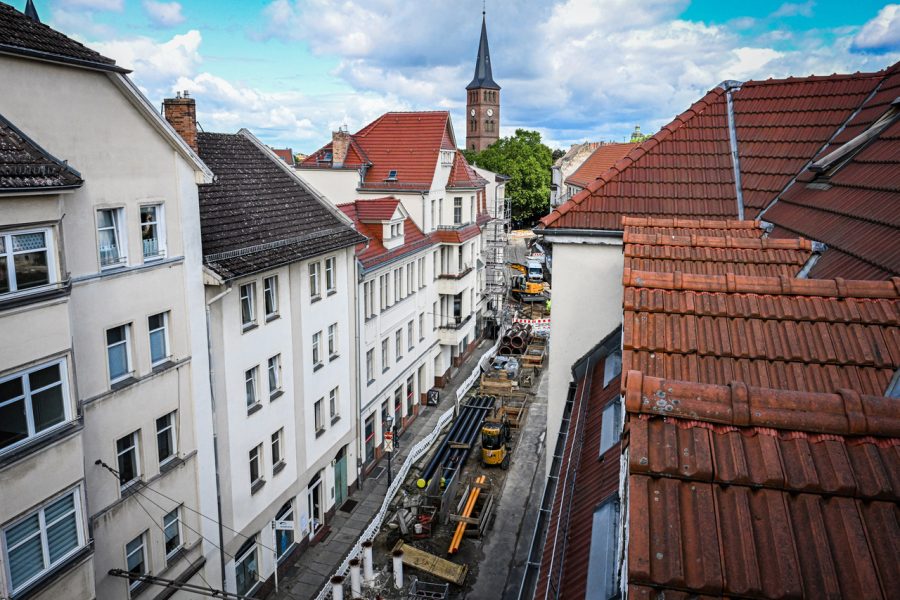
(Header image: © Stefano Valtorta | Unsplash)

Author:

More From WahlheYmatPost

  • StimmlosTrend 2026: 96 Percent Would Vote If They Could

    StimmlosTrend 2026: 96 Percent Would Vote If They Could

    Around one million people living in Berlin do not hold a German passport, 851,000 of whom are adults. They cannot vote in elections to the Berlin House of Representatives – and their political views are therefore largely absent from traditional election polling. WahlheYmat created StimmlosTrend 2026 to make these perspectives visible. Inspired by the BerlinTrend…

  • Berlin Wiki: How Do You Decide Who to Vote For? 

    Berlin Wiki: How Do You Decide Who to Vote For? 

    How Do You Decide Which Party to Vote For? Many people find it difficult to decide which party to vote for. But instead of not voting at all, it is important to inform yourself thoroughly. Democracy is based on people making decisions together based on their own convictions. To do so, voters need to be…

  • Who Will Lead Germany Into Its International Future?

    Who Will Lead Germany Into Its International Future?

    What does the story of Charles De Gaulle teach us? Antonin Baudry’s La Bataille de Gaulle tells, in five hours, the story of the General during the Second World War. A great movie. I learned a lot. Tenacity. De Gaulle arrives alone in London. On 18 June 1940, he makes his first BBC speech, speaking…

  • Berlin Wiki: What Are the Key Issues in Berlin’s Election?

    Berlin Wiki: What Are the Key Issues in Berlin’s Election?

    Why Is Rent Policy a Central Issue in Berlin’s Election Campaign? Around 85 percent of Berliners live in rented accommodation. At the same time, the housing market in the capital is tight: rents are rising, new housing construction remains sluggish, and legal loopholes frequently allow furnished apartments to be offered at inflated prices. This is…

  • A Mayor Tandem for Berlin

    A Mayor Tandem for Berlin

    What if Berlin had two Regierende Bürgermeister:innen? One representing the city’s elected voice — and another representing the voice of Berlin’s international residents who live, work and contribute here but do not have German citizenship and therefore cannot vote in Berlin elections. Because in a democratic society, it can’t be right that 25% of the…

  • Berlin Wiki: Equal Access to Democracy

    Berlin Wiki: Equal Access to Democracy

    What Impact Does Berlin’s Electoral Reform Have? In September 2023, Berlin’s House of Representatives (AGH) adopted an amendment to the state constitution lowering the voting age from 18 to 16. The aim of the constitutional amendment is to strengthen the democratic participation of young people. The new rule will apply for the first time in…

  • No German Passport? You May Still Have a Vote in Berlin 

    No German Passport? You May Still Have a Vote in Berlin 

    If you are an EU citizen living in Berlin but do not have German citizenship, you cannot vote in the election for Berlin’s House of Representatives (Abgeordnetenhaus). But you can vote for your local District Assembly (Bezirksverordnetenversammlung, or BVV) if you meet the eligibility requirements. Around 240,000 non-German EU citizens are eligible to take part…

  • The Signature That Didn’t Count – Finding My Voice in Berlin

    The Signature That Didn’t Count – Finding My Voice in Berlin

    When I moved to Berlin in the spring of 2022, I was approached one sunny afternoon by people carrying clipboards under their arms. Would I like to sign a petition? I was pleasantly surprised by this request – such a sense of community in Berlin, what a place to have come to live. With a…

  • StimmlosTrend: A New Survey Wants to Hear Berlin’s Missing Voices

    StimmlosTrend: A New Survey Wants to Hear Berlin’s Missing Voices

    Can’t vote in Berlin? There are a million people like you. We’re giving them a voice. That’s the message of WahlheYmat’s new StimmlosTrend campaign, which launches today. Modern democracy is built on elections. In Berlin, the House of Representatives is elected every five years by eligible German citizens (EU citizens can only vote in district…

  • “Berlin taught me to dislike the word integration” 

    “Berlin taught me to dislike the word integration” 

    WHP: You worked in humanitarian aid around the world for many years. What ultimately motivated you to found Just-Go-For-It? Marilena Chatziantoniou: I started working in the field of humanitarian aid in 1998. My first assignment was in Albania, where I worked for a small German NGO, just months before the Kosovo crisis. I remember falling…

  • What is Germany’s greatest asset?

    What is Germany’s greatest asset?

    “Football is a simple game. Twenty-two men chase a ball for 90 minutes and, in the end, the Germans always win,” said Gary Lineker after England lost the 1990 World Cup semi-final on penalties against Germany. Times are changing. Germany no longer always wins at major football tournaments. And England now has a German coach.…

  • Migrants With Degrees Are Not What Germany Is Looking For

    Migrants With Degrees Are Not What Germany Is Looking For

    Education is a right, not a privilege. This idea has been a founding principle of modern democracies. In practice, however, access to education is far from guaranteed for everyone. As of this year, Germany has significantly restricted access to state-funded intermediate and advanced German courses for migrants participating voluntarily. Many rejected asylum seekers, people with…

  • Berlin Wiki: Ways to Influence Politics in Berlin

    Berlin Wiki: Ways to Influence Politics in Berlin

    What is a Volksentscheid? A Volksentscheid, or referendum, allows Berliners to vote directly on proposed legislation and political issues outside regular elections, or to trigger an early election. Anyone who is eligible to vote in elections to the Berlin House of Representatives (Abgeordnetenhaus) is also eligible to take part in a Volksentscheid. A Volksentscheid can…

  • Berlin Wiki: How Berlin’s Government Is Formed

    Berlin Wiki: How Berlin’s Government Is Formed

    How Is the Government Formed? Berlin’s state government is the Senate. It consists of the Governing Mayor and ten senators. Every five years, a new Senate is formed. During coalition negotiations, the parliamentary groups agree on common political goals, the distribution of government portfolios and the budget. Afterwards, the members of the Berlin House of…

  • Berlin Wiki: Democracy and the Principles of Free Elections

    Berlin Wiki: Democracy and the Principles of Free Elections

    What Does Democracy Mean? A great deal could be written about what democracy is. Put simply, in a democracy, all state authority is derived from the people. This means that the citizens of a country determine its political direction. Germany is a parliamentary and representative democracy: citizens elect representatives who make decisions on their behalf.…

  • Berlin Wiki: Who Influences Political Decisions? 

    Berlin Wiki: Who Influences Political Decisions? 

    What Is Lobbying? Lobbying is the organised effort by interest groups to influence political decisions. The term is derived from the word “lobby,” referring to the entrance halls of parliaments where representatives of various interests traditionally met with members of parliament to discuss and promote their concerns. Lobbying takes place in almost every area of…

  • Berlin Wiki: Finding Reliable Information Before You Vote

    Berlin Wiki: Finding Reliable Information Before You Vote

    What Is the Wahl-O-Mat? The Wahl-O-Mat has been provided by the Federal Agency for Civic Education (Bundeszentrale für politische Bildung, bpb) since 2002. It is an online voting advice tool that allows users to compare their own political positions with those of political parties in Germany. Anyone using the Wahl-O-Mat can respond to a series…

Address

Am Hamburger Bahnhof 3
10557 Berlin
Germany

hey@wahlheymat.de

Social Networks