
Education is a right, not a privilege. This idea has been a founding principle of modern democracies. In practice, however, access to education is far from guaranteed for everyone.
As of this year, Germany has significantly restricted access to state-funded intermediate and advanced German courses for migrants participating voluntarily. Many rejected asylum seekers, people with insecure residence status, and migrants without access to welfare benefits are now expected to cover the costs themselves.
Due to a lack of financial means to continue learning German, many are forced to get by with basic language skills, which massively limits their opportunities on the job market. Additionally, work that does not require advanced language skills is typically low-income—perpetuating the vicious cycle.
From Buenos Aires to Berlin
Darío Farcy and his team at the sociocultural center Lohana Berkins are determined to find a way out. Named after an emblematic figure of the feminist and trans rights movement in Argentina, this space aims to equip immigrants for the challenges that come with starting a new life in a foreign country.
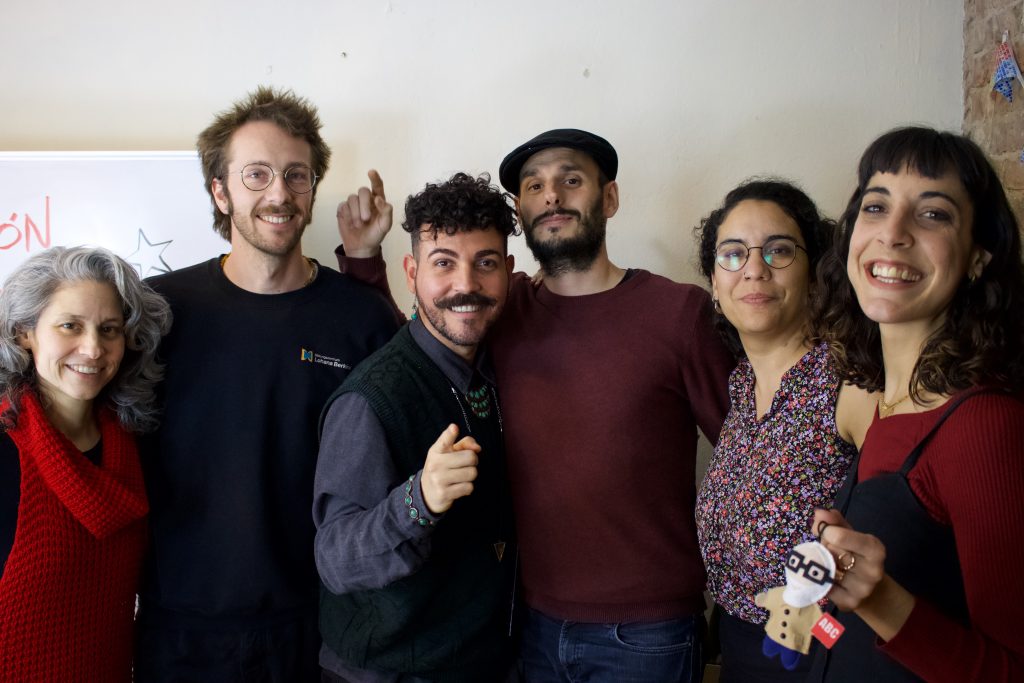
Darío, one of the founders of the center, grew up in a province near Buenos Aires. His parents were both doctors who worked up to thirteen hours a day, but the family was never particularly wealthy. Instead of opening or joining private clinics, they chose to dedicate their efforts and expertise to the public health system.
“The quote ‘You are either the oppressed or the oppressor’ has always been a recurring theme in my family history,” Darío reminisces. “For my parents, this meant continuing to offer their help where it was most needed instead of climbing the social ladder.” Two of Farcy’s grandparents were teachers; his grandmother fought on the frontlines of the women’s education movement in the 1950s.
His family’s heritage, alongside Argentina’s strong emphasis on solidarity and social justice, led Darío to dedicate his studies to exploring power dynamics in politics and society. “I was the only one in my friend group who went to university. Because of this, I always shared as much as I could with people around me who didn’t have this opportunity,” the political scientist explains.
Educación Popular – education from below
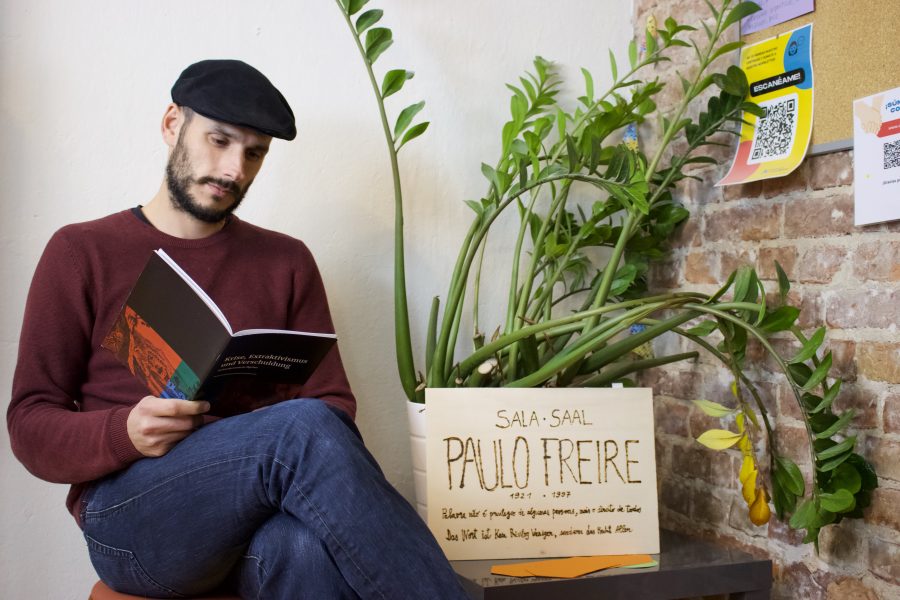
This was when he became familiar with the concept of popular education (Educación Popular), coined by Brazilian historian and philosopher Paulo Freire. Educación Popular is a teaching style designed to facilitate the inclusion of marginalized groups through horizontal dialogue between teacher and student about shared experiences. The left-wing social organization Frente Popular Darío Santillán (FPDS) put this idea into action: They built independent schools in recovered factories and slums, creating educational facilities in impoverished areas. Then, through street protests, they demanded that the state validate the diplomas from these popular schools and pay teacher salaries.
After finishing his degree, Darío Farcy joined the FPDS movement and became an educator in one of these establishments, teaching political economy and the history of the working class. Shortly before leaving the country, he worked at the Fedecaba (Federación de Cooperativas Autogestivas de Buenos Aires). This federation coordinates dialogue between grassroots workers’ cooperatives and the state.
Right before the COVID-19 pandemic, Darío decided to move to Berlin to reunite with his girlfriend and broaden his horizons in a foreign society. Though he has always felt welcomed in the capital, he initially struggled to find work due to a lack of language skills and job opportunities in his field.
‘You realize what kind of jobs Germany needs immigrants for”
“Migrants with an academic background are not what this society is most interested in,” he remarks. “When you look at who drives the taxis, who delivers the pizzas, and who builds the houses, you realize what kind of jobs Germany needs immigrants for.” After this difficult start, Farcy decided to take matters into his own hands in 2021, launching the idea of an education center based on the principle of Educación Popular by Freire.
“Back in Argentina, organizations were everything. If someone was struggling, the community would always unite and find a solution,” says the founder of Lohana Berkins center. By gathering a team of engaged, politically conscious people around him, he found a solution for himself and his community.
The center started as an educational space, offering a complete German language course and a political economy course taught in Spanish. Over time, Lohana Berkins center has become a sociocultural space, incorporating artistic pedagogical methods like theater and storytelling. This facilitates the peer-to-peer communication that is crucial to the Educación Popular approach.
“There has been an explosion of projects,” the founder adds. For instance, a new addition to the center’s curriculum discusses freelancers’ working rights—a fairly unexplored yet highly relevant topic for immigrants. Importantly, all of these courses are free, making education at Lohana Berkins center accessible to all, regardless of social, cultural, or financial background.
“Education doesn’t change the world. Education changes people. People change the world.” — This quote by Paulo Freire is the slogan of the sociocultural center. By allowing education to fulfill its function as a social equalizer, Darío Farcy and his team hope to move toward a more just, democratic, and inclusive society.
(Header image: © Bildungszentrum Lohana Berkins)