
From Kyiv to Berlin: War Changed His Path, but Not His Dream

Borbála Hanna Dévai,

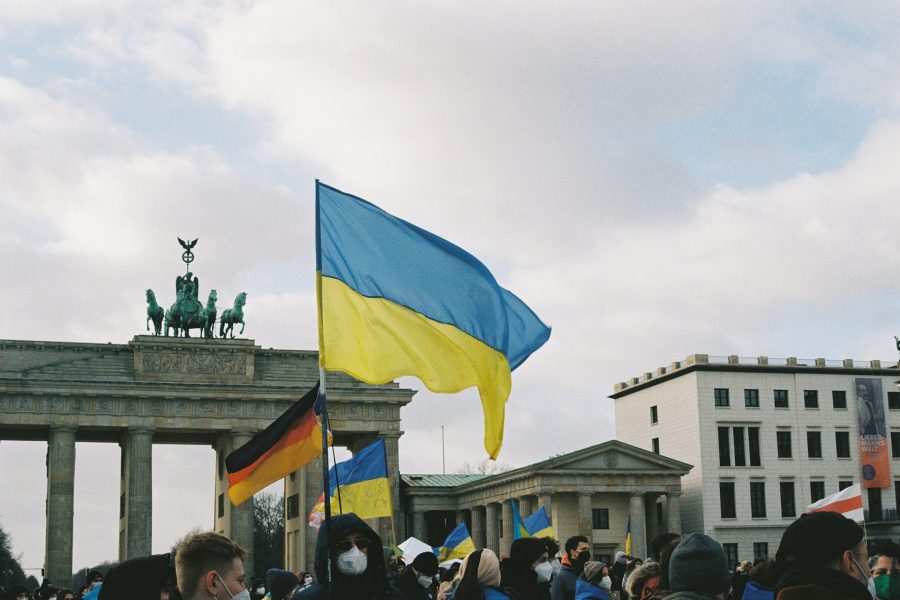
Ukraine flag Brandenburger Tor
At 15, Oleksandr Drevytskyi left Kyiv with his mother and their dog Ozzy after Russia’s full-scale invasion of Ukraine. In Berlin, he found himself navigating a new language, a new school system and an uncertain future. Four years later, he is studying mathematics at Humboldt University – and helping other Ukrainians find their own way through the city.

“The war is here – those were the words my mom woke me up with that morning,” Oleks recalls. On February 24th, 2022, the life of 15-year-old Oleksandr (Oleks) Drevytskyi was changed forever. Leading up to the devastating Russian attack, expectations about the future of the ongoing conflict varied across Ukraine. While many had established escape plans and were mentally preparing to leave behind their home country and loved ones, Oleks and his family were still hopeful that human decency would prevent the Russian government from escalating the conflict. 

“In that moment, I was incapable of feeling anything. I was in shock. So I just started packing my things quietly,” Oleksandr remembers. First, the Kyivan family was planning to join Oleksandr’s great-grandmother in Bucha, a city in the north of Ukraine. But by the time they were ready to leave, the area had been declared a war zone. As missile attacks on the capital intensified, staying put was no longer an option. The family moved to the city of Kalynivka in central Ukraine to live with Oleksandr’s grandfather. 

“I knew it would be safer for us in another country”

After about a week, his mother, a genetic scientist, received an offer that turned out to be a lifeline: a scholarship to work at the Max Planck Institute for one year, with accommodation provided for the duration of the job. Similar offers were extended to Ukrainian researchers by institutions around the world in the aftermath of the invasion. Finally, the family had a chance to be safe. Except not all of them could leave.

Following the declaration of martial law in February 2022, most Ukrainian men aged 18 to 60 were legally banned from leaving the country to ensure sufficient personnel for military mobilization. Oleksandr’s father had to stay. “I knew it would be safer for us in another country, but I dreaded having to leave behind family and everything I was used to. All I could think was that I don’t want to move again,” Oleksandr confesses. 

On the 11th of March, it was time to say goodbye. Oleksandr, his mother, two of her colleagues, and the family dog, Ozzy, named after Ozzy Osbourne, drove off into the unknown. After a tense three-day journey, they finally arrived in the German capital. Despite arriving during the last few days of the lengthy and frigid Berlin winter, Oleksandr and his mother received a warm welcome. “The people at the Max Planck Institute helped us settle in and make our first connections in a foreign city. My mom’s boss would invite us to go on hikes and day trips with her and her family.” 

Starting over in Berlin

Back home, Oleksandr was a top student. Though his life had taken a dramatic turn, his education remained a priority, and he continued regularly attending the online classes of his Ukrainian high school. For Oleks, having to transition to a completely different education system from the one in which he had excelled was difficult to come to terms with. Even more so because it meant acknowledging that the relocation wouldn’t be as temporary as initially hoped. 
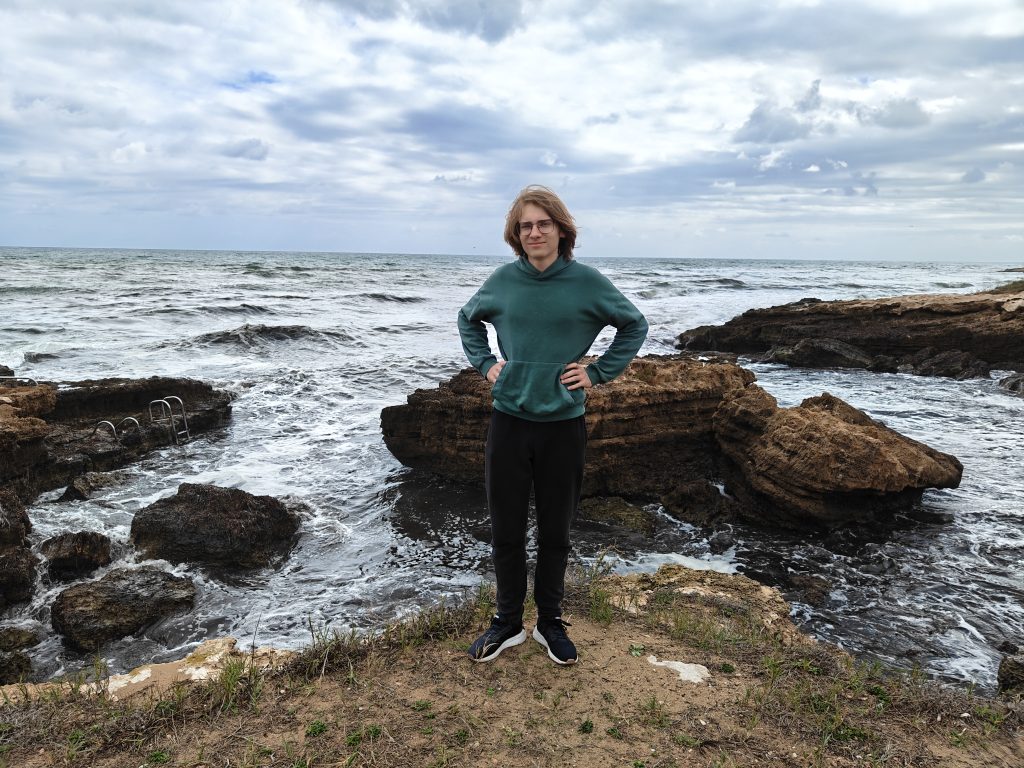
oplus_2097152

In addition, the sheer bureaucratic burden of enrolling a foreign adolescent in a German high school often proves to be a considerable challenge. Fortunately, Oleksandr’s grandmother was able to visit and offer support shortly before the new school year started. “The first three Gymnasiums either replied that they had no capacity left or needed more documents from my previous school that we couldn’t access. Lessing Gymnasium in Wedding was the first place willing to hear us out,” Oleksandr explains. After the school administration had examined his flawless report cards and advanced German-language certificate, he was granted a spot in the upcoming 11th grade. 

The first person to notice Oleksandr’s exceptional talent at his new school was his maths teacher, who was also head of the department. What stood out to her was that Oleks didn’t just memorize and apply complex mathematical formulas but also took pleasure in understanding their origins and theoretical foundations. Witnessing his enthusiasm, she encouraged him to participate in the Maths Olympiad, in which the school’s best participants move on to compete in larger-scale contests.

In the year following his arrival, he placed first in his district and seventh in Berlin. The following year, he took the district title once again and placed fourth in the entire capital.  

A talent for mathematics

From there, it only made sense to test Oleks’ abilities in the Bundeswettbewerb Mathematik, where participants solve increasingly challenging problems over the course of months. In this contest, Oleks won second prize in both the first and second rounds, putting him in the top 1 to 2 percent of participants. 

At Lessing Gymnasium, about three-fourths of students have a migration background. Growing up in Eastern Europe, this kind of diversity wasn’t quite the norm. But to Oleks, it was comforting to know that many students could relate to his experiences as an immigrant. Gaining confidence and adapting to his new environment, he soon caught up with his fellow students – and then surpassed them. 

In the German Abitur system, grade averages from 1.5 to 1.0 are considered excellent, almost guaranteeing that graduates can pursue higher education at their desired institutions. Achieving this goal is seen as an impressive outcome for German students, and an especially remarkable accomplishment for someone who had to adapt to a completely new education system.

Though Oleks didn’t think much of his performance in the Abitur exams, his results proved otherwise. Out of a maximum of 900 points, he scored 845 points, earning him the perfect grade point average of 1.0 and the best Abitur result at the entire school – just two years after arriving in Germany. After evaluating his written Abitur assignment on polynomial roots, the maths department agreed that Oleks’ exam paper was at master’s thesis level. 

Turning talent into a future

Just as he was about to finally pursue his passion – studying mathematics at Humboldt University of Berlin – Oleks faced another challenge. His mother’s contract came to an end in 2023. Since then, she has been learning German and depending on basic income support. However, when Oleksandr started university, the amount of financial support his mother received was significantly reduced. To finance his studies, he therefore had to rely on either a student loan or a scholarship. 

He applied for scholarships from the Konrad-Adenauer-Stiftung (KAS) and Studienstiftung des deutschen Volkes (SdV) – two of the most prestigious programmes in Germany. To his surprise, he was first accepted by KAS and shortly after by SdV, the latter only being awarded to around 0.5 percent of students in Germany. As an SdV scholar, he could pursue his mathematics degree without the financial pressure. “My life didn’t turn out the way I imagined when I was little,” Oleks reflects. “Then again, I always knew that I wanted to become a mathematician. Though the path leading me there is different from the one I originally expected, I feel it is now my responsibility to make my dream a reality.” 

Based on his academic achievements, one might picture Oleks as a rather solitary prodigy, hardly interested in anything outside his own intellectual field. On the contrary, his pastimes like playing chess, listening to music, walking Ozzy and spending time with his friends from Lessing are just as important to him as to any uni student. 

Another passion of Oleksandr’s over the past year has been leading mathematics clubs at various schools, where he introduces students to challenging problems beyond the regular curriculum and encourages them to discover the creativity and joy of mathematics.

On top of that, Oleksandr is engaged in community integration support: He regularly accompanies Ukrainians in need to doctors’ appointments or immigration offices, translating for them and helping with paperwork. These services are organized through a community Telegram chat where Ukrainian immigrants can seek support from their compatriots. 

Finally, keeping in touch with his family back in Ukraine and closely following the news about his home country will always remain an important part of Oleks’s everyday life. Having attended countless solidarity protests in Berlin against the Russian invasion, he is convinced that the only effective weapon against Putin is a unified Europe and continued military support for Ukraine. “I always read the news about the war – as a Ukrainian, I feel it is my duty. But I made myself one promise: I will try my best not to look at the pictures.” 

(Header image: © Vujadin Zdravković | Pixabay)
Author:

More From WahlheYmatPost

  • From Kyiv to Berlin: War Changed His Path, but Not His Dream

    From Kyiv to Berlin: War Changed His Path, but Not His Dream

    “The war is here – those were the words my mom woke me up with that morning,” Oleks recalls. On February 24th, 2022, the life of 15-year-old Oleksandr (Oleks) Drevytskyi was changed forever. Leading up to the devastating Russian attack, expectations about the future of the ongoing conflict varied across Ukraine. While many had established…

  • The Berlin Election Is Over – The Work Begins

    The Berlin Election Is Over – The Work Begins

    What do the Berlin election results tell us? Our TOP 3 takeaways 1. Housing won Housing is clearly the central issue in Berlin, as StimmlosTrend also showed. Die Linke won by putting housing at the top of its agenda. Many citizens now hope they can deliver. 2. Voting with gloves Many people vote against a…

  • Strangers by the Spree: Inside Berlin’s Outdoor Latin Dance Community

    Strangers by the Spree: Inside Berlin’s Outdoor Latin Dance Community

    Feierabend! A busy weekday is coming to an end, and Hauptbahnhof is becoming crowded with tired Berliners: businessmen with briefcases heading home after a long day at work, groups of schoolgirls huddled up on benches apathetically scrolling on TikTok, and exhausted travelers searching for the S-Bahn that will finally take them to their accommodation.  The…

  • StimmlosTrend 2026: 96 Percent Would Vote If They Could

    StimmlosTrend 2026: 96 Percent Would Vote If They Could

    Around one million people living in Berlin do not hold a German passport, 851,000 of whom are adults. They cannot vote in elections to the Berlin House of Representatives – and their political views are therefore largely absent from traditional election polling. WahlheYmat created StimmlosTrend 2026 to make these perspectives visible. Inspired by the BerlinTrend…

  • Who Will Lead Germany Into Its International Future?

    Who Will Lead Germany Into Its International Future?

    What does the story of Charles De Gaulle teach us? Antonin Baudry’s La Bataille de Gaulle tells, in five hours, the story of the General during the Second World War. A great movie. I learned a lot. Tenacity. De Gaulle arrives alone in London. On 18 June 1940, he makes his first BBC speech, speaking…

  • A Mayor Tandem for Berlin

    A Mayor Tandem for Berlin

    What if Berlin had two Regierende Bürgermeister:innen? One representing the city’s elected voice — and another representing the voice of Berlin’s international residents who live, work and contribute here but do not have German citizenship and therefore cannot vote in Berlin elections. Because in a democratic society, it can’t be right that 25% of the…

  • No German Passport? You May Still Have a Vote in Berlin 

    No German Passport? You May Still Have a Vote in Berlin 

    If you are an EU citizen living in Berlin but do not have German citizenship, you cannot vote in the election for Berlin’s House of Representatives (Abgeordnetenhaus). But you can vote for your local District Assembly (Bezirksverordnetenversammlung, or BVV) if you meet the eligibility requirements. Around 240,000 non-German EU citizens are eligible to take part…

  • “Berlin taught me to dislike the word integration” 

    “Berlin taught me to dislike the word integration” 

    WHP: You worked in humanitarian aid around the world for many years. What ultimately motivated you to found Just-Go-For-It? Marilena Chatziantoniou: I started working in the field of humanitarian aid in 1998. My first assignment was in Albania, where I worked for a small German NGO, just months before the Kosovo crisis. I remember falling…

  • What is Germany’s greatest asset?

    What is Germany’s greatest asset?

    “Football is a simple game. Twenty-two men chase a ball for 90 minutes and, in the end, the Germans always win,” said Gary Lineker after England lost the 1990 World Cup semi-final on penalties against Germany. Times are changing. Germany no longer always wins at major football tournaments. And England now has a German coach.…

  • Migrants With Degrees Are Not What Germany Is Looking For

    Migrants With Degrees Are Not What Germany Is Looking For

    Education is a right, not a privilege. This idea has been a founding principle of modern democracies. In practice, however, access to education is far from guaranteed for everyone. As of this year, Germany has significantly restricted access to state-funded intermediate and advanced German courses for migrants participating voluntarily. Many rejected asylum seekers, people with…

  • Two birthdays, one dream for Berlin

    Two birthdays, one dream for Berlin

    WahlheYmat was launched as an initiative on 15 September 2023, with Democracy Day providing the occasion. So this week, we turn three years old. Some international Berliners, including our co-founders, asked the question: If Berlin has become diverse and international, wouldn’t it be better to govern the city together? We had almost a hundred conversations…

  • Berlin Wiki: Election Day – From Casting Your Vote to the Results 

    Berlin Wiki: Election Day – From Casting Your Vote to the Results 

    What Happens on Election Day? Election day is when eligible voters in a democracy are called on to cast their ballots. Voting and Counting the Votes In Germany, elections must be held on a Sunday or a public holiday. Polling stations are generally open from 8 a.m. to 6 p.m. They are often located in…

  • Berlin Wiki: How Do You Decide Who to Vote For? 

    Berlin Wiki: How Do You Decide Who to Vote For? 

    How Do You Decide Which Party to Vote For? Many people find it difficult to decide which party to vote for. But instead of not voting at all, it is important to inform yourself thoroughly. Democracy is based on people making decisions together based on their own convictions. To do so, voters need to be…

  • Berlin Wiki: What Are the Key Issues in Berlin’s Election?

    Berlin Wiki: What Are the Key Issues in Berlin’s Election?

    Why Is Rent Policy a Central Issue in Berlin’s Election Campaign? Around 85 percent of Berliners live in rented accommodation. At the same time, the housing market in the capital is tight: rents are rising, new housing construction remains sluggish, and legal loopholes frequently allow furnished apartments to be offered at inflated prices. This is…

  • Berlin Wiki: Equal Access to Democracy

    Berlin Wiki: Equal Access to Democracy

    What Impact Does Berlin’s Electoral Reform Have? In September 2023, Berlin’s House of Representatives (AGH) adopted an amendment to the state constitution lowering the voting age from 18 to 16. The aim of the constitutional amendment is to strengthen the democratic participation of young people. The new rule will apply for the first time in…

  • Berlin Wiki: Ways to Influence Politics in Berlin

    Berlin Wiki: Ways to Influence Politics in Berlin

    What is a Volksentscheid? A Volksentscheid, or referendum, allows Berliners to vote directly on proposed legislation and political issues outside regular elections, or to trigger an early election. Anyone who is eligible to vote in elections to the Berlin House of Representatives (Abgeordnetenhaus) is also eligible to take part in a Volksentscheid. A Volksentscheid can…

  • Berlin Wiki: How Berlin’s Government Is Formed

    Berlin Wiki: How Berlin’s Government Is Formed

    How Is the Government Formed? Berlin’s state government is the Senate. It consists of the Governing Mayor and ten senators. Every five years, a new Senate is formed. During coalition negotiations, the parliamentary groups agree on common political goals, the distribution of government portfolios and the budget. Afterwards, the members of the Berlin House of…

  • Berlin Wiki: Democracy and the Principles of Free Elections

    Berlin Wiki: Democracy and the Principles of Free Elections

    What Does Democracy Mean? A great deal could be written about what democracy is. Put simply, in a democracy, all state authority is derived from the people. This means that the citizens of a country determine its political direction. Germany is a parliamentary and representative democracy: citizens elect representatives who make decisions on their behalf.…

Address

Am Hamburger Bahnhof 3
10557 Berlin
Germany

hey@wahlheymat.de

Social Networks