
Berlin Wiki: From Postal Voting to the Ballot Box 

WahlheYmatPost,

Wahllokal
In the next chapter of our Berlin Wiki series, we take a closer look at the practical side of elections in Germany. We explain how to apply for postal voting, what information is included in a voter notification, how polling stations work, and how to correctly fill out a ballot paper.

How Does Postal Voting Work?

In Germany, voters can choose to vote by post instead of going to a polling station on election day.

Information on how to apply for postal voting can be found in the voter notification that eligible voters receive in the weeks before the election. Depending on the municipality, voter notifications may also include a QR code that leads directly to an online application.

Once the application has been submitted, the polling card and postal voting documents are usually sent by post. These documents contain envelopes in different colours, which are determined by the municipalities. The completed ballot paper is placed in one envelope, which is then placed together with the signed polling card in another envelope. The postal ballot return letter can then be sent within Germany by post free of charge. Postal voting documents mailed from abroad must have sufficient postage.

Polling cards can be requested until the Friday before the election at the latest. In exceptional cases, such as illness, applications can still be submitted until 3 p.m. on election Sunday. In this case, however, the documents must be collected in person or by an authorized representative.

Anyone who has received their postal voting documents but has not sent them in on time can deliver them in person to the responsible election office until 6 p.m. on election day. Postal ballots arriving after 6 p.m. will not be counted.

What Is a Polling Station?

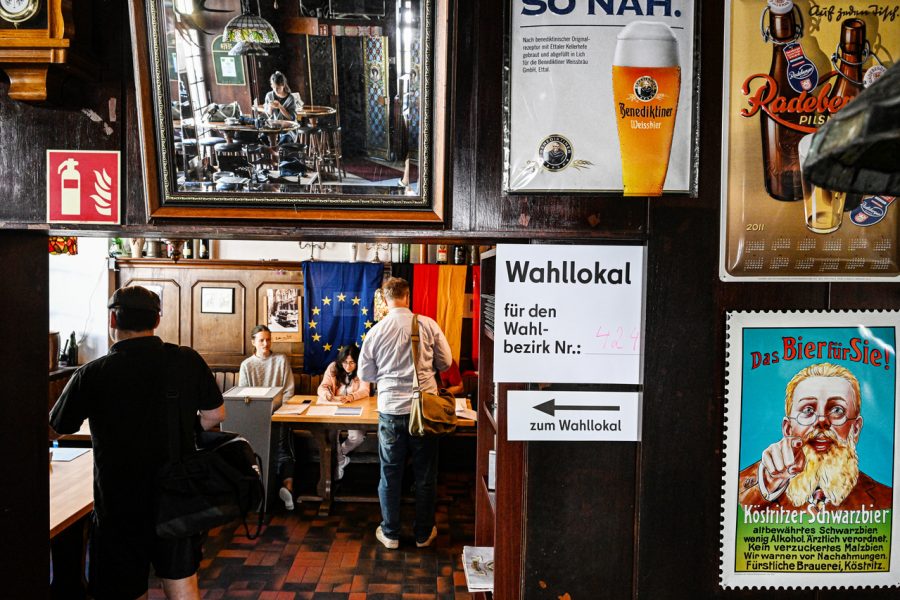
Most Germans vote at polling stations. There, ballot papers are placed directly into a ballot box. Polling stations do not exist all year round. Rather, public facilities, often schools, are converted into polling stations. Cities are divided into many electoral districts. In Berlin, for example, there are 2,220 polling districts with ballot boxes and just as many polling stations. Polling stations are also often located in restaurants or pubs. This is where the German word Wahllokal comes from. Lokal is another word for a restaurant or pub.

Voters can find out which polling station – and which room – they are assigned to from their voter notification, which arrives by post. This should be brought to the polling station, along with an identity card. Election workers then check whether the person is listed in the electoral register and hand out a ballot paper.

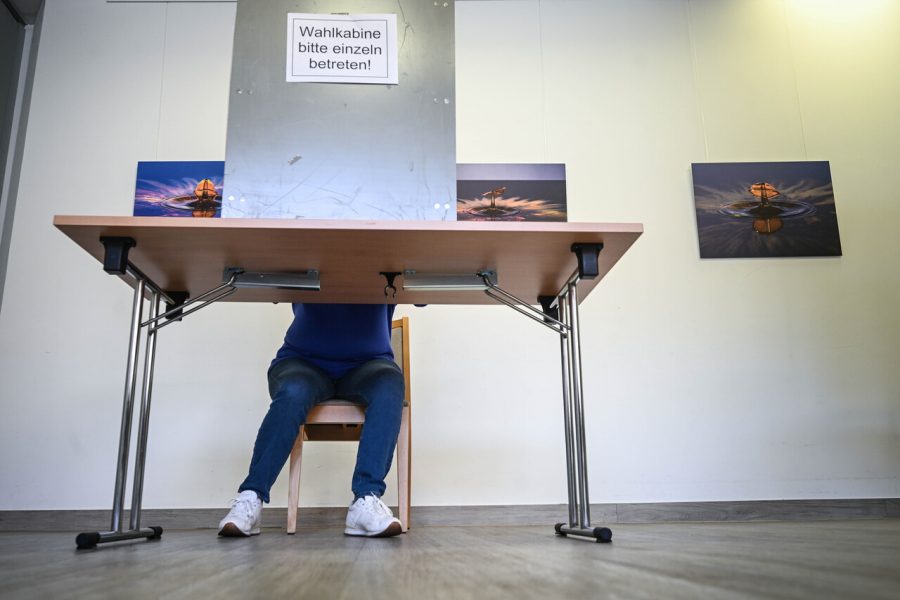
The ballot paper is marked behind a privacy screen because voting is secret. The folded ballot paper is then placed into the ballot box.

If the voter notification has been lost, the responsible election office can be contacted by phone to find out the correct polling station. This is often also possible through an online service portal. An identity card alone is sufficient for voting at the polling station.

What Is a Voter Notification?

Anyone who is eligible to vote, is registered as a resident in a municipality and is listed in the electoral register, normally receives a voter notification by post in good time before elections. The voter notification is generally sent four to six weeks before the election by the municipalities or, in Berlin, by the district election offices.

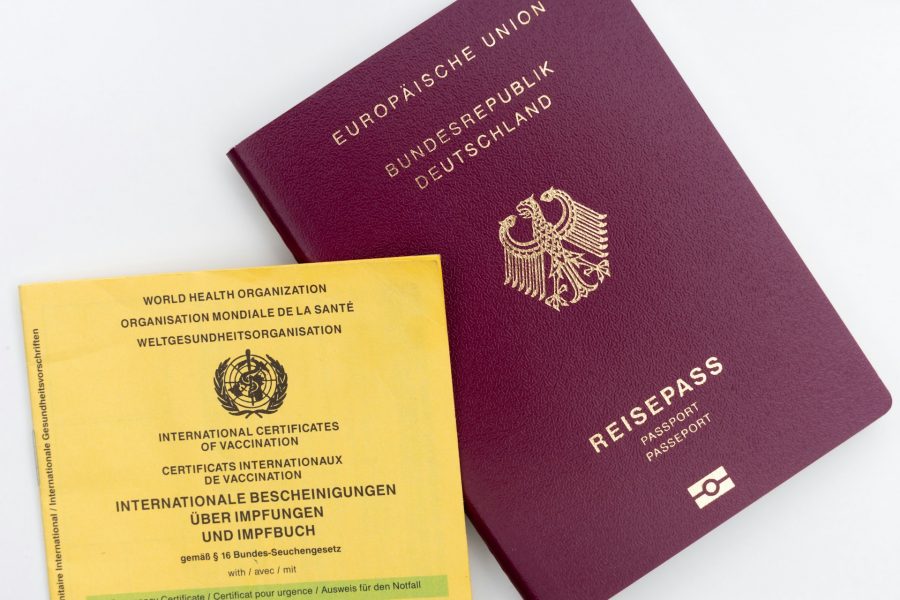
The voter notification must be sent to eligible voters no later than the 21st day before the election. The document states which election is taking place and when it will be held. It also indicates the polling station and room where the voter can cast their ballot and whether the location is accessible. Ideally, the voter notification should be kept and brought to the polling station, but it is not mandatory; an official identification document (such as an identity card or passport) is sufficient.

The voter notification also contains an explanation of how to apply for a polling card, which allows a person either to vote by post or at another polling station within their own constituency.

If a voter notification has still not arrived several days after the legally prescribed mailing date, it may mean that the eligible voter is not entered in the electoral register. In that case, the person concerned should contact the municipality or, in Berlin, the responsible district election office. During a legally defined period before the election, it is possible to inspect the electoral register and file an objection if one’s name has been omitted by mistake; in federal elections, this is usually possible from the 20th to the 16th day before the election.

How Do You Fill Out a Ballot Paper?

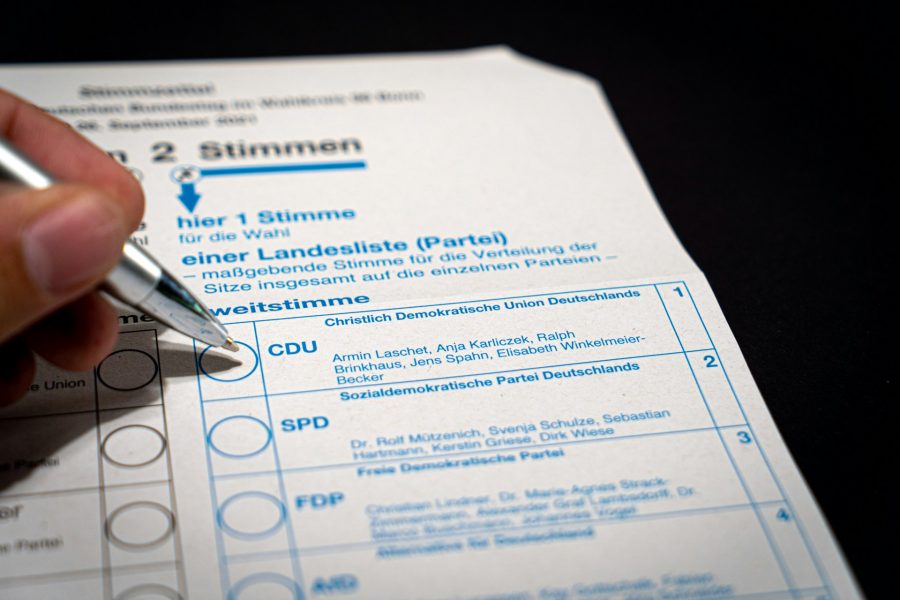
Whether it is a federal election or a local election, ballot papers in German elections can look different. At the top, the ballot paper states which election it is for. Below this, depending on the election, there is a list of parties, electoral lists or candidates. The arrangement of this information varies depending on the election.

In federal elections, voters have two votes. The second vote is used to vote for a party’s state list rather than an individual candidate. Both votes can be cast independently of one another.

Depending on the election, the voting options may appear on one or several ballot papers. The top of the ballot paper also states how many marks may be made on it.

Depending on the election, voters may receive additional ballot papers, for example for another election, a referendum, or a popular initiative taking place at the same time. It is important to pay attention to which election is named at the top of the ballot paper.

Ballot papers are marked in secret behind a privacy screen. A circle is printed next to each option for marking the choice. No additional or ambiguous markings should be made outside the designated fields. Otherwise, the vote may be considered invalid.

Here you can find the Berlin Wiki page of Berliner Morgenpost.

(Header image: © FUNKE Foto Services | Maurizio Gambarini)

Author:

More From WahlheYmatPost

  • Who Will Lead Germany Into Its International Future?

    Who Will Lead Germany Into Its International Future?

    What does the story of Charles De Gaulle teach us? Antonin Baudry’s La Bataille de Gaulle tells, in five hours, the story of the General during the Second World War. A great movie. I learned a lot. Tenacity. De Gaulle arrives alone in London. On 18 June 1940, he makes his first BBC speech, speaking…

  • Berlin Wiki: What Are the Key Issues in Berlin’s Election?

    Berlin Wiki: What Are the Key Issues in Berlin’s Election?

    Why Is Rent Policy a Central Issue in Berlin’s Election Campaign? Around 85 percent of Berliners live in rented accommodation. At the same time, the housing market in the capital is tight: rents are rising, new housing construction remains sluggish, and legal loopholes frequently allow furnished apartments to be offered at inflated prices. This is…

  • A Mayor Tandem for Berlin

    A Mayor Tandem for Berlin

    What if Berlin had two Regierende Bürgermeister:innen? One representing the city’s elected voice — and another representing the voice of Berlin’s international residents who live, work and contribute here but do not have German citizenship and therefore cannot vote in Berlin elections. Because in a democratic society, it can’t be right that 25% of the…

  • Berlin Wiki: Equal Access to Democracy

    Berlin Wiki: Equal Access to Democracy

    What Impact Does Berlin’s Electoral Reform Have? In September 2023, Berlin’s House of Representatives (AGH) adopted an amendment to the state constitution lowering the voting age from 18 to 16. The aim of the constitutional amendment is to strengthen the democratic participation of young people. The new rule will apply for the first time in…

  • No German Passport? You May Still Have a Vote in Berlin 

    No German Passport? You May Still Have a Vote in Berlin 

    If you are an EU citizen living in Berlin but do not have German citizenship, you cannot vote in the election for Berlin’s House of Representatives (Abgeordnetenhaus). But you can vote for your local District Assembly (Bezirksverordnetenversammlung, or BVV) if you meet the eligibility requirements. Around 240,000 non-German EU citizens are eligible to take part…

  • The Signature That Didn’t Count – Finding My Voice in Berlin

    The Signature That Didn’t Count – Finding My Voice in Berlin

    When I moved to Berlin in the spring of 2022, I was approached one sunny afternoon by people carrying clipboards under their arms. Would I like to sign a petition? I was pleasantly surprised by this request – such a sense of community in Berlin, what a place to have come to live. With a…

  • StimmlosTrend: A New Survey Wants to Hear Berlin’s Missing Voices

    StimmlosTrend: A New Survey Wants to Hear Berlin’s Missing Voices

    Can’t vote in Berlin? There are a million people like you. We’re giving them a voice. That’s the message of WahlheYmat’s new StimmlosTrend campaign, which launches today. Modern democracy is built on elections. In Berlin, the House of Representatives is elected every five years by eligible German citizens (EU citizens can only vote in district…

  • “Berlin taught me to dislike the word integration” 

    “Berlin taught me to dislike the word integration” 

    WHP: You worked in humanitarian aid around the world for many years. What ultimately motivated you to found Just-Go-For-It? Marilena Chatziantoniou: I started working in the field of humanitarian aid in 1998. My first assignment was in Albania, where I worked for a small German NGO, just months before the Kosovo crisis. I remember falling…

  • What is Germany’s greatest asset?

    What is Germany’s greatest asset?

    “Football is a simple game. Twenty-two men chase a ball for 90 minutes and, in the end, the Germans always win,” said Gary Lineker after England lost the 1990 World Cup semi-final on penalties against Germany. Times are changing. Germany no longer always wins at major football tournaments. And England now has a German coach.…

  • Migrants With Degrees Are Not What Germany Is Looking For

    Migrants With Degrees Are Not What Germany Is Looking For

    Education is a right, not a privilege. This idea has been a founding principle of modern democracies. In practice, however, access to education is far from guaranteed for everyone. As of this year, Germany has significantly restricted access to state-funded intermediate and advanced German courses for migrants participating voluntarily. Many rejected asylum seekers, people with…

  • Berlin Wiki: Ways to Influence Politics in Berlin

    Berlin Wiki: Ways to Influence Politics in Berlin

    What is a Volksentscheid? A Volksentscheid, or referendum, allows Berliners to vote directly on proposed legislation and political issues outside regular elections, or to trigger an early election. Anyone who is eligible to vote in elections to the Berlin House of Representatives (Abgeordnetenhaus) is also eligible to take part in a Volksentscheid. A Volksentscheid can…

  • Berlin Wiki: How Berlin’s Government Is Formed

    Berlin Wiki: How Berlin’s Government Is Formed

    How Is the Government Formed? Berlin’s state government is the Senate. It consists of the Governing Mayor and ten senators. Every five years, a new Senate is formed. During coalition negotiations, the parliamentary groups agree on common political goals, the distribution of government portfolios and the budget. Afterwards, the members of the Berlin House of…

  • Berlin Wiki: Democracy and the Principles of Free Elections

    Berlin Wiki: Democracy and the Principles of Free Elections

    What Does Democracy Mean? A great deal could be written about what democracy is. Put simply, in a democracy, all state authority is derived from the people. This means that the citizens of a country determine its political direction. Germany is a parliamentary and representative democracy: citizens elect representatives who make decisions on their behalf.…

  • Berlin Wiki: Who Influences Political Decisions? 

    Berlin Wiki: Who Influences Political Decisions? 

    What Is Lobbying? Lobbying is the organised effort by interest groups to influence political decisions. The term is derived from the word “lobby,” referring to the entrance halls of parliaments where representatives of various interests traditionally met with members of parliament to discuss and promote their concerns. Lobbying takes place in almost every area of…

  • Berlin Wiki: Finding Reliable Information Before You Vote

    Berlin Wiki: Finding Reliable Information Before You Vote

    What Is the Wahl-O-Mat? The Wahl-O-Mat has been provided by the Federal Agency for Civic Education (Bundeszentrale für politische Bildung, bpb) since 2002. It is an online voting advice tool that allows users to compare their own political positions with those of political parties in Germany. Anyone using the Wahl-O-Mat can respond to a series…

  • Berlin Wiki: Understanding Political Parties

    Berlin Wiki: Understanding Political Parties

    What Is an Election Manifesto? Before an election, political parties present their election manifestos. This applies in federal, state, and local elections. In the manifestos, parties set out in writing the goals they intend to pursue. These goals reflect the issues that are important to the party during the upcoming legislative term—that is, the electoral…

Address

Am Hamburger Bahnhof 3
10557 Berlin
Germany

hey@wahlheymat.de

Social Networks