
Why Is Rent Policy a Central Issue in Berlin’s Election Campaign?
Around 85 percent of Berliners live in rented accommodation. At the same time, the housing market in the capital is tight: rents are rising, new housing construction remains sluggish, and legal loopholes frequently allow furnished apartments to be offered at inflated prices. This is why rent policy is one of the central issues in Berlin’s election campaign.
The Berlin parties agree on some housing policy measures. Almost all major parties – the CDU, the SPD, the Greens and Die Linke – support the consistent enforcement of the rent brake as well as the introduction of a rent register to create greater transparency in the housing market or to help combat excessive rents. Only the AfD opposes both proposals.
However, each party has its own priorities when it comes to regulating the rental market. The CDU and AfD place greater emphasis on private investors, deregulation in new housing construction and support for property owners. The SPD, Greens and Die Linke, on the other hand, want to provide greater support for public housing construction and public-interest organisations such as housing cooperatives.
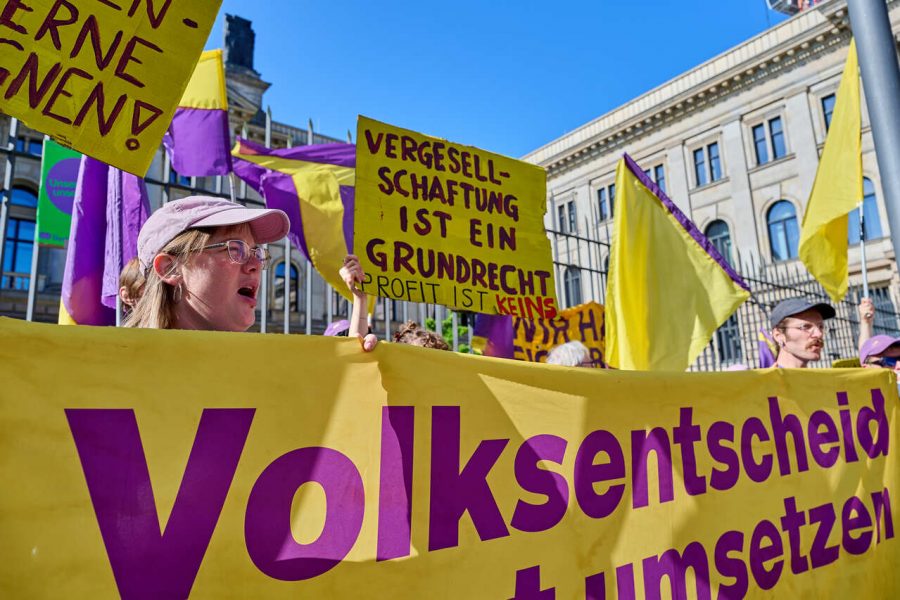
The parties’ positions also differ significantly when it comes to the socialisation of large housing companies. The debate was triggered by the successful referendum initiated by the Berlin campaign “Deutsche Wohnen & Co enteignen” in 2021. So far, however, the result of the referendum has yet to be implemented. The CDU and AfD strictly oppose socialisation, while the Greens and Die Linke explicitly support it. The SPD takes a more cautious stance on the proposal but does not rule out the use of this instrument.
Why Is Transport Policy a Central Issue in Berlin’s Election Campaign?
Transport in Berlin is a highly controversial issue: pedestrians, cyclists, motorists and users of public transport regularly compete for limited public space. While some prioritise mobility that is as fast and efficient as possible, others want more traffic-calmed areas in order to reduce noise and improve road safety. Berlin’s policymakers must weigh these competing interests transport policy.
Car-friendly positions include maintaining the 50 km/h speed limit on main roads, dismantling Kiezblocks and bollards, continuing construction of the A100 city motorway and creating additional parking spaces. Parties that want to reduce car traffic in the city, on the other hand, focus on expanding alternative means of transport, raising fees for resident parking permits and restricting through traffic in order to create car-free or low-car neighbourhoods.
There is, however, agreement on public transport: all major parties contesting the election in Berlin want to expand public transport and make it more attractive. Their demands include expanding the transport network, adding more stops, increasing service frequency, automating certain rail lines and digitalising ticket purchases. Some parties support more bicycle parking facilities at stations, discounted social tickets and major recruitment efforts at the BVG and the S-Bahn.
All major parties also support expanding cycling infrastructure. However, they differ on the extent of the measures: while some want to limit expansion to areas where it is particularly necessary, others call for a continuous cycling network, more bicycle streets and more protected, physically separated cycle paths and lanes.
All parties also want to provide better protection for pedestrians. Their goals include more places to cross safely, better lighting and wider, barrier-free paths.
Why Is Education Policy a Central Issue in Berlin’s Election Campaign?
Berlin’s education system faces major challenges. Some districts still lack sufficient school places, the shortage of teachers is worsening, and universities are struggling with financial constraints. Despite some progress – for example, through the school construction initiative and an easing of the shortage of daycare places – Berlin’s policymakers still have numerous issues to address.
In Germany, education is the responsibility of the federal states. The federal government can encourage and support nationwide standards, but responsibility for the design of the education system lies with the states. Berlin therefore decides independently on school structures, curricula, school holidays and examination requirements. The main responsibility lies with the Senate Department for Education, Youth and Family.
Key education policy demands include reducing the teacher shortage and improving staffing levels at schools and after-school care facilities. Many parties also advocate smaller classes, stronger support for pupils with special educational needs and further digitalisation in schools. Assessment methods, the structure of the school system and access to secondary schools, on the other hand, remain contentious. Proposals range from retaining traditional grades to introducing alternative forms of assessment, and from a more differentiated school system to an expansion of comprehensive school models.
Berlin is an internationally renowned centre of higher education with numerous universities and other higher education institutions. At the same time, higher education policy faces major challenges because of budget pressures. Planned or already approved spending cuts are leading to job losses and a growing backlog of renovation work. In the long term, they could also reduce the range of degree programmes and the number of university places.
(Header image: © FUNKE Foto Services | Maurizio Gambarini)