

What Does the First Vote Decide?
The article looks at how voters elect candidates and parties in Bundestag elections and elections to the Berlin House of Representatives, and how seats in parliament are distributed through proportional representation.
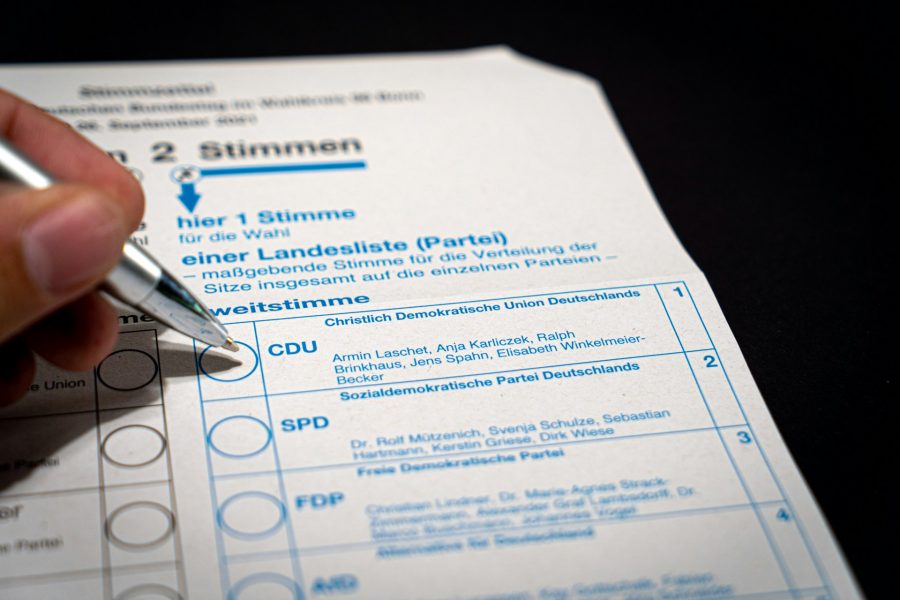
In Bundestag elections or elections to the House of Representatives, voters cast both a first vote and a second vote. With the first vote, citizens choose a candidate directly in their electoral district. Each party may nominate one candidate per district.
The winner is determined according to the first-past-the-post principle (“winner takes all”), meaning that the candidate with the most votes receives the direct mandate. This gives the candidate the right to enter the Bundestag or the House of Representatives if their party has won enough seats through the second vote. If a party has fewer seats than direct mandates, the constituency winners with the highest vote shares in their electoral district enter parliament first until all seats are filled.
The first vote is an instrument intended to ensure the representation of many electoral districts and local interests in the Bundestag or the House of Representatives. All electoral districts have similarly sized populations (on average 240,000 in 2023), and the maximum deviation is limited to 25 percent, meaning that each candidate represents a similar number of people. However, only German citizens are counted in this calculation.
What Does the Second Vote Decide?
With the second vote, voters decide through proportional representation how many seats a party receives in parliament. First, seats are filled by the constituency winners elected through the first vote. If there are still seats remaining, candidates from the state party list may enter parliament in order until all seats have been allocated.
The second vote is cast directly for a party and cannot be used to change the party’s composition or election program. It is simply considered as approval or rejection of the party’s plans for the respective election. Only the first vote allows voters to choose candidates directly.
How Does Proportional Representation Work?
In a proportional representation system, a party receives the same proportion of seats as the proportion of second votes it receives. This means that if a party receives 14 percent of the votes, it is entitled to 14 percent of the seats in parliament. How fractional results are handled is determined in advance. Votes for parties that receive less than five percent of the vote are not taken into account in the distribution of seats.
In elections to the Bundestag or the House of Representatives, a mixed-member proportional representation system is used. This means that proportional representation (second vote) is combined with the election of a direct candidate in each electoral district (first vote). As a result, the overall distribution of parties in parliament can be determined while voters also have more influence on the personal composition of parliament.
Here you can find the Berlin Wiki page of Berliner Morgenpost.
(Header image: © FUNKE Foto Services | Markus Weissenfels)