
What does the Bezirksamt actually do, and why should you care?

Berlin

Most Berliners know the Bezirksamt as the place where they wait weeks for a Bürgeramt appointment. But behind the paperwork lies one of the most important layers of democracy in the city — the level of government that shapes daily life in every neighborhood.

Berlin often feels like two cities at once: a capital where decisions of national importance are made, and a patchwork of neighborhoods where daily life unfolds. Somewhere between these levels sits an institution that many international residents barely know — the Bezirksamt, the district office. For anyone trying to understand how Berlin works, this is one of the most important yet overlooked parts of the city’s political life.

Berlin’s Twelve Districts

Berlin is divided into twelve districts, each with its own Bezirksamt. While the Senate of Berlin sets city-wide policies, the Bezirksamt is responsible for making them tangible in everyday life. It is the executive branch of the district, led by a district mayor and several councillors, each of whom is responsible for different areas such as education, urban development, or social affairs. Put simply, the Bezirksamt is the level of government that most directly affects your neighborhood.
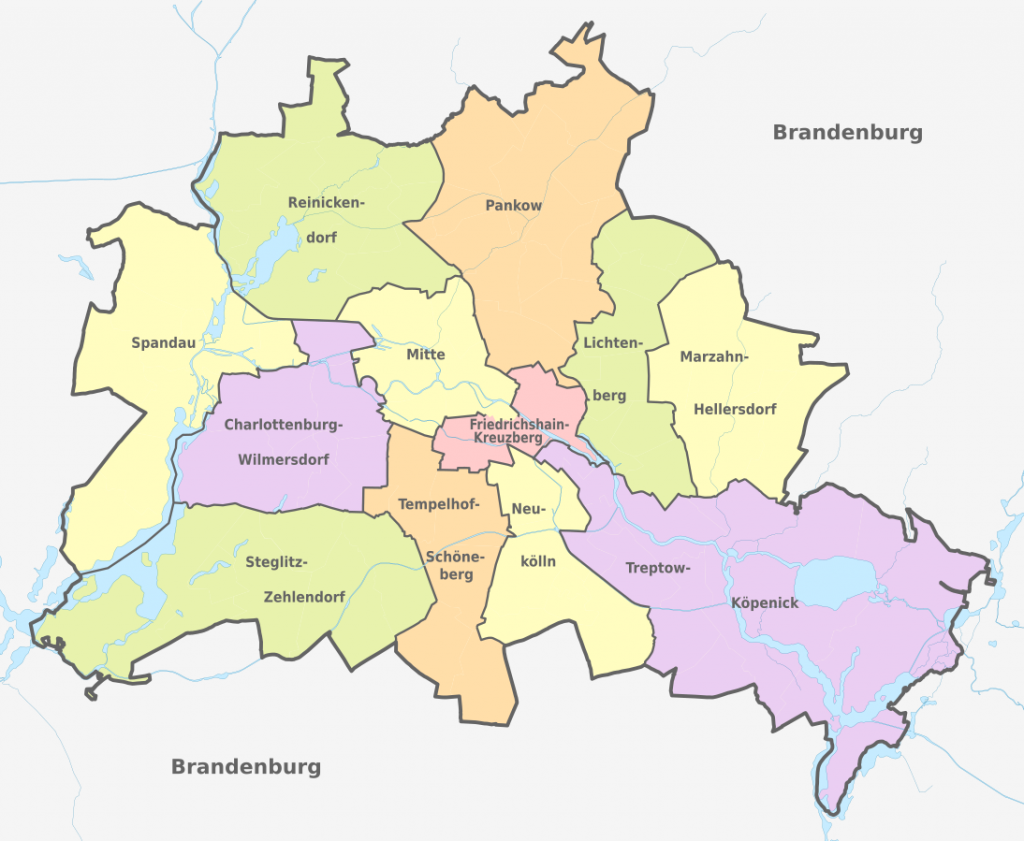
Berlin districts

@Wikimedia Commons

When you register your address at the Bürgeramt, the appointment you struggle to book is organized under the umbrella of the Bezirksamt. When you walk through a local park, use a public library, or send your child to a kindergarten, the conditions you encounter are shaped by decisions at this district level. Even the small things, like whether a broken playground is repaired quickly or whether a cultural center in your Kiez receives funding, are handled not by the Senate but by your local district administration.

Behind these practicalities lies a structure of local democracy. The Bezirksamt does not operate in isolation but in constant dialogue with the Bezirksverordnetenversammlung, or BVV, the district council. The BVV is made up of elected representatives who decide on the priorities of the district and supervise the work of the Bezirksamt. Their debates often concern the things that most visibly influence people’s lives: which school should be renovated first, where new bike lanes should be built, how funds should be distributed among local cultural projects. The Bezirksamt then has the task of putting these decisions into practice.

How to get involved?

District councils (BVV) are open to the public. You can attend their meetings, ask questions, or submit petitions — even if you don’t hold German citizenship. EU citizens can vote in district elections. Check your district’s BVV website for meeting dates and opportunities to participate.

Why It Matters for International Residents

For international residents, this can seem like a distant process, but it is actually the closest level of government you can encounter in Berlin. EU citizens living here can vote in BVV elections, and all residents can attend council sessions or even submit questions and petitions. Unlike the national parliament or the Senate, the district council meets in a building that is probably only a few tram stops away from your apartment. It is the point where local democracy is most visible and, at least in theory, most accessible.

It is also the arena where frustration often builds up. Long waiting times for Bürgeramt appointments, endless paperwork, or the feeling that simple issues take years to resolve — all of this is associated with the Bezirksamt. Yet the very fact that the district offices are responsible for so many everyday services means that they are also the places where you can demand change. Understanding their role is the first step toward using them, and using them is the first step toward making Berlin feel more livable.

The Invisible Layer That Shapes the City

The Bezirksamt is not glamorous. It does not make international headlines, and it rarely features in national debates. But it is the invisible layer of government that quietly shapes the rhythm of the city. The school your child attends, the playground around the corner, the cultural programs that make your neighborhood vibrant — all of these depend on decisions made within your district’s town hall.

To care about the Bezirksamt is to care about the everyday life of your community. And to engage with it, even just by understanding what it does, is to take part in shaping Berlin from the ground up. That is why, even if the German bureaucracy feels like a maze, taking the time to learn how your district office works is worth it. Because once you know where decisions are made, you also know where your voice can make a difference.

Bezirksamt vs. Bürgeramt — What’s the Difference?

Many people in Berlin confuse these two terms — understandably so!
Bezirksamt is the district government. It’s led by the district mayor and councillors and is responsible for schools, kindergartens, social services, city planning, green spaces, and cultural support. It’s the political and administrative level that shapes everyday life in your district.
Bürgeramt is part of the Bezirksamt — the local citizen’s office where you go for everyday paperwork: registering your address, getting an ID card or passport, renewing a driver’s license, or certifying documents.
In short: The Bezirksamt governs, the Bürgeramt serves.

Author:

More From WahlheYmatPost

  • Berlin Wiki: How Berlin’s Government Works 

    Berlin Wiki: How Berlin’s Government Works 

    What Makes Berlin’s Governing Mayor Special? Whoever holds the office of Governing Mayor is both the head of government and the ceremonial head of the city of Berlin. The House of Representatives (Abgeordnetenhaus) votes on who will hold the position. There has even been a case in which someone won the election without being their…

  • Migrants With Degrees Are Not What Germany Is Looking For

    Migrants With Degrees Are Not What Germany Is Looking For

    Education is a right, not a privilege. This idea has been a founding principle of modern democracies. In practice, however, access to education is far from guaranteed for everyone. As of this year, Germany has significantly restricted access to state-funded intermediate and advanced German courses for migrants participating voluntarily. Many rejected asylum seekers, people with…

  • Berlin Wiki: How Do the First and Second Vote Work? 

    Berlin Wiki: How Do the First and Second Vote Work? 

    What Does the First Vote Decide? The article looks at how voters elect candidates and parties in Bundestag elections and elections to the Berlin House of Representatives, and how seats in parliament are distributed through proportional representation. In Bundestag elections or elections to the House of Representatives, voters cast both a first vote and a…

  • Tempelhofer Feld: Berlin’s Most Emotional Urban Conflict Is Back 

    Tempelhofer Feld: Berlin’s Most Emotional Urban Conflict Is Back 

    We are approaching an election in September. Hopefully, you’re reading along in the Berlin Wiki to bone up on how stuff works in German elections, the lexicon, and the issues. Well, one of the issues we’re going to see debated concerns the Tempelhofer Feld. So let’s talk about that for a bit.  The other night,…

  • Berlin Wiki: Parties, Direct Mandates and the Five-Percent Threshold 

    Berlin Wiki: Parties, Direct Mandates and the Five-Percent Threshold 

    What Is a Political Party? A political party is an association of citizens regulated by the German Federal Party Law. Political parties aim to influence political decision-making at federal or state level over a longer period of time and may represent voters in state parliaments or in the Bundestag. First of all, a party needs…

  • Good Intentions Are Not Democratic Enough

    Good Intentions Are Not Democratic Enough

    “What you do for me, but without me, you do against me” — the exact origin of this quote is unclear. Nevertheless, it captures something that frequently happens in Germany when it comes to the political participation of historically excluded groups. Policies are supposedly made for migrants, yet not with them. Gender equality is debated…

  • What Happened When I Tried to Organize My Neighbors 

    What Happened When I Tried to Organize My Neighbors 

    There’s a lot of talk today about building community. At our March WahlheYmat Talk, the crowd brought up the subject, specifically that we should be creating more of it. Ideas flew around the room. We are living in an era of schism, where the people pulling the levers of power are trying to create an…

  • Home Is Not a Place: A Berlin Exhibition Rethinks Migration

    Home Is Not a Place: A Berlin Exhibition Rethinks Migration

    How do people change after moving from one place to another? What do they leave behind and what do they carry with them? Is it possible to feel at home in a space that is vastly different from the one we left? In her latest installation “Remembering Space (how much past can the present hold)”,…

  • Berlin Wiki: Who Is Allowed to Vote – and Why Not Everyone Can

    Berlin Wiki: Who Is Allowed to Vote – and Why Not Everyone Can

    Who is allowed to vote, and who is not? In a democratic state like Germany, the right to vote is of central importance. It allows citizens to take part in political decision-making and help determine the composition of the government. In Germany, voters must meet certain requirements in order to vote. They must hold German…

  • Berlin Wiki: Party Profiles II – The Greens, The Left, the AfD and the BSW party

    Berlin Wiki: Party Profiles II – The Greens, The Left, the AfD and the BSW party

    What is the Green Party? Bündnis 90/Die Grünen is an important political force in the Berlin House of Representatives. Although the party has not been part of the government since the 2023 election, it operates from the opposition within parliament. Its guiding principle is ecological, economic, and social sustainability. It focuses on stronger climate protection,…

  • Berlin Wiki: Party Profiles I — Which Parties Shape the Capital?

    Berlin Wiki: Party Profiles I — Which Parties Shape the Capital?

    Which parties are important in Berlin? Berlin has many political parties, each pursuing its own agenda. These parties are organized at different levels. Many have a Berlin state association, as well as several district and local branches. The parties that receive the most votes form parliamentary groups in the House of Representatives, Berlin’s parliament. The…

  • The Good, the Bad, and the Arbeitsamt

    The Good, the Bad, and the Arbeitsamt

      Most places have an arm of the government to help folks out when they’re unemployed; governments like their citizens to have jobs and pay taxes. It tends to keep the governments – and the citizens – happy. There’s also the matter of not letting people starve in the street when they’re out of work.…

  • Berlin Wiki: Your Guide to the 2026 Berlin Election

    Berlin Wiki: Your Guide to the 2026 Berlin Election

    What will be elected in Berlin in 2026? On September 20, 2026, a new House of Representatives will be elected in Berlin. At the same time, the district assemblies of Berlin’s twelve districts will also be elected. The electoral term is always five years. Voters therefore decide which parties and politicians will serve in these…

  • “Das Volk” in 2026: Time to Redefine the People

    “Das Volk” in 2026: Time to Redefine the People

    “Do you behave as the person you truly want to be?” I ask myself this question in moments when I clearly fall short. Yes, it is hard to live up to one’s ideal self—I’m probably not the only one who feels this way. The same applies for societies. Over the past ten years, I have…

  • “Treat Every Case as Your Own”: How Zaki e.V. Supports Berlin’s Overlooked Migrants

    “Treat Every Case as Your Own”: How Zaki e.V. Supports Berlin’s Overlooked Migrants

    WHP: Can you briefly introduce Zaki e.V.? What is your main mission in Berlin? Pia Bergmann: Zaki – Bildung und Kultur e.V. is a migrant-led organization, with its main office located at the Berlin Global Village in Neukölln and another office in Pankow. The organization’s focus can be summed up in one sentence: arrival and…

Address

Am Hamburger Bahnhof 3
10557 Berlin
Germany

hey@wahlheymat.de

Social Networks