

WHP: Can you briefly introduce your initiative? What is its main mission in Berlin?
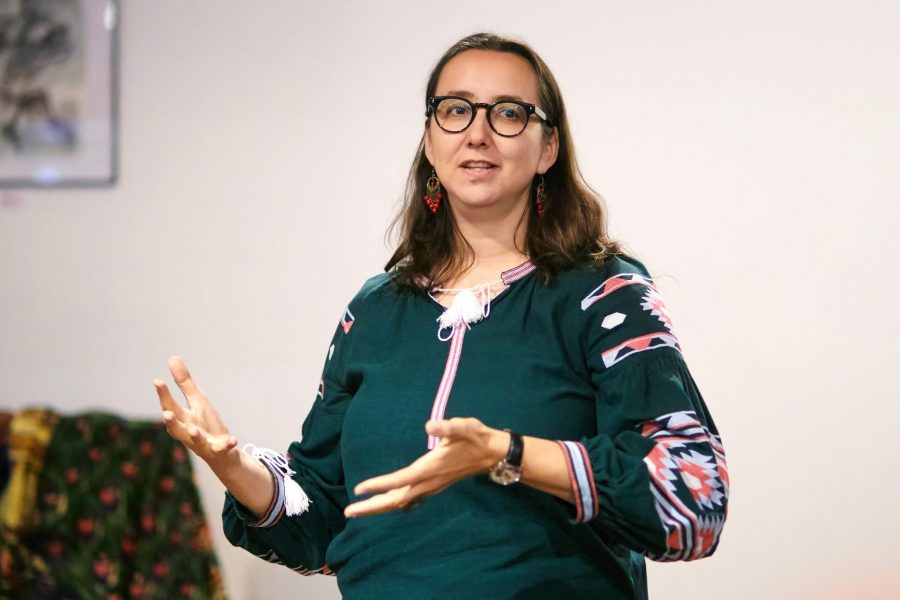
Tetyana Lavuta: Svoji.de is an online platform that increases the visibility of Ukrainian civic initiatives in Berlin and Brandenburg and supports their networking with other migrant communities. The name evokes a sense of belonging and safety: the Ukrainian word “svoji” (written in Latin script) refers to people, places, or things that are familiar and close.
The “.de” domain not only signals Germany as the local context but also plays on the Ukrainian word “de” (“where”). This creates a dual meaning: on the one hand, a connection to German society; on the other, a place where “one’s own” gather, act, and interact within global networks. This layered meaning reflects the project’s core purpose — to help Ukrainian refugees find like-minded people, support one another, connect with other communities, and become visible and influential within German society.
WHP: What personally motivated you to get involved?
Tetyana Lavuta: The scale of the Ukrainian presence in Germany is a key motivation of mine. As of 2025, more than 1.25 million refugees from Ukraine live in Germany, with over 90,000 in Berlin alone. This makes Ukrainians the second-largest migrant community in the city — and an extremely active one. In less than four years, Ukrainians have established numerous organizations, volunteer projects, and educational and cultural spaces for both children and adults.
Volunteers organize events that bring people seeking protection together, making an important contribution to social cohesion. However, information about all of this is scattered across social media and messaging apps. That is why the idea of Svoji.de emerged: to bring everything together on one platform where events, initiatives, and locations can be easily found using filters, dates, and districts.
WHP: What challenges do people with a migration background face in Berlin — and how does your organization address them?
Tetyana Lavuta: People with migration experience, including Ukrainian refugees, face discrimination — particularly in the labor market. First and last names often reveal a foreign background, and studies show that people with non-German names receive significantly fewer responses from employers. In addition, the temporary protection status of Ukrainians is time-limited, which some employers perceive as a risk, alongside assumptions about language barriers or integration challenges. Naturally, rejection letters do not state this explicitly, making discrimination difficult to prove.
On Svoji.de, we publish information about counseling centers where people can learn how to counter discrimination and assert their rights, as well as contacts for social and psychological support. Our goal is to ensure that everyone has access to tools to protect their rights and dignity, drawing on Berlin’s Participation Act (Partizipationsgesetz), which guarantees equal participation for migrants in society.
WHP: Do you have an upcoming project, event, or initiative you would recommend to our readers?
Tetyana Lavuta: The Svoji.de platform launched at the end of December 2025 and continues to grow as a living digital space. At the moment, our focus is on the “Globale Stimmen” section, designed to amplify the voices of migrant and Ukrainian communities in Berlin and Brandenburg. We believe that exchanging experiences and fostering solidarity make activists stronger, help drive social change, and contribute to building a more just world.
We support organizations in becoming more visible, finding partners, and learning together. If you organize informational, educational, or discussion-based events on equality, community development, or global issues — such as ecology or social responsibility within Global South discourse — tell us about them. Adding an event to the calendar is easy: simply fill out the short form on the Globale Stimmen page and upload your poster. Your project will gain more visibility, friends, and allies.
WHP: How can interested people support your work or get involved themselves?
Tetyana Lavuta: The project was launched with the support of the Deutsche Stiftung für Engagement und Ehrenamt through the program “action! – Aktiv für eine globale Welt.” Svoji.de is a young initiative that relies on support from migrant organizations and communities. Add your events to the website — together we can spread knowledge about global connections and encourage active participation in civic life.