
WHP: Could you briefly introduce SINGA Deutschland? What is its main mission in Berlin?
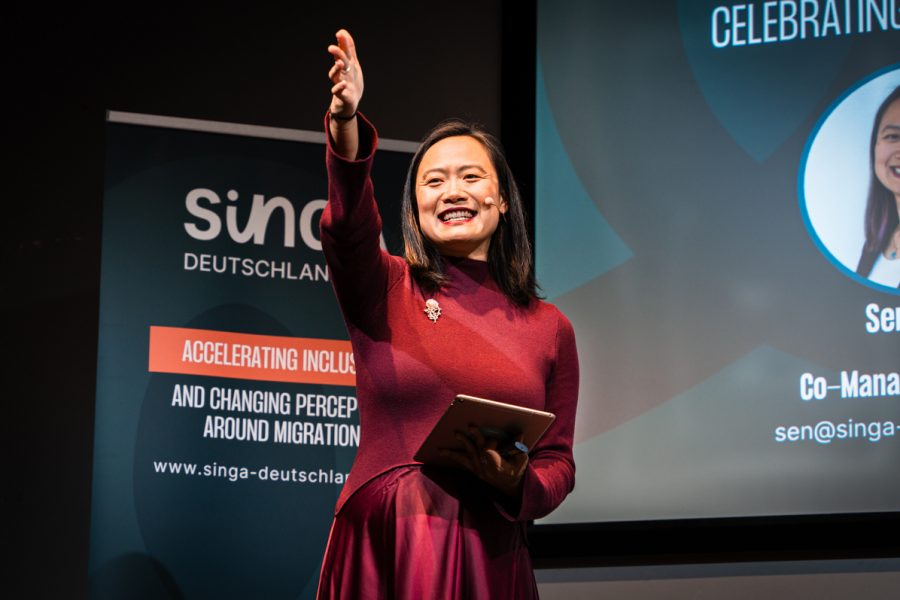
Sen Zhan: SINGA Deutschland was founded in 2016 by a brilliant team of three co-founders — Luisa Seiler, Sima Gatea, and Vinzenz Himmighofen — as a humanitarian response at a moment when many newcomers were arriving in Germany. From the beginning, the work was not only about immediate support, but about creating a sense of welcome and human connection in a time of great uncertainty. Today, SINGA Deutschland is co-led by Ramona Hinkelmann and myself, with a small and dedicated team.
At the heart of our work is building belonging by actively bridging different parts of the entrepreneurial ecosystem: newcomers and long-term residents, early-stage founders and established organizations, lived experience and institutional knowledge. We focus on creating practical pathways that allow people to work together, learn from one another, and turn ideas into something real.
Entrepreneurship is one of our main vehicles for this. By supporting newcomer founders and teams working on solutions to real challenges — such as access to work, housing, language learning, and administrative navigation — we help turn ideas into viable ventures, services, and products that benefit the wider society. Strengthening the entrepreneurial ecosystem is therefore about creating real pathways into the economy, not just offering inspiration.
A core part of SINGA’s approach is supporting the human side of innovation. We look beyond surface-level measures of economic value and recognize the full range of potential people bring with them—such as resilience built through migration, cross-cultural insight, informal leadership, community-building skills, and the ability to navigate complexity and uncertainty. These qualities often don’t show up neatly on a CV, but they are essential for building meaningful, sustainable ventures.
Through our programs, awards, and partnerships, we combine community-building with hands-on venture support. Founders leave with clearer business models, stronger networks, and practical tools, while Berlin gains new businesses, services, and innovations shaped by diverse perspectives. At its core, SINGA is about turning arrival into contribution — and contribution into a shared sense of belonging for the city as a whole.
WHP: What personally motivated you to become involved in this work?
Sen Zhan: My parents were first-generation immigrants, and I am a 1.5 generation immigrant who never stopped moving. With each migration to another continent, I learned what it meant to recreate myself yet again. That means not only many career changes, but huge shifts in social networks, orientation to society, and my understanding of my life path. A big part of these re-creation experiences meant that my accomplishments or skills from previous chapters were not recognized in the new place I went, and I had to rebuild many foundational pieces from scratch. Seeing how prevalent this experience was in the newcomer community, and how much potential was lost when people didn’t have easily accessible entry points and structures to contribute their ideas, it felt obvious that creating these opportunities for others to be able to give would benefit not only the newcomer community, but all of society.
I have seen that when the opportunities are there for people to give the gifts they have, be they business ideas, community-building initiatives, cultural-sharing events, or extending care to others through connection, that many other problems solve themselves. Anxiety, frustrations, and uncertainty fall into the background, while strength, creativity, and brilliance come into the foreground.
WHP: What challenges do people with migrant backgrounds face in Berlin, and how does your organisation respond to them?
Sen Zhan: What I’ve seen across many newcomer communities is that there is rarely a lack of ability, ideas, or desire to succeed. People who have it in them to move their lives — often across countries or continents — are unsurprisingly also driven to create the best possible outcomes for themselves and their communities. The challenge is much more about access, orientation, social capital, and the support structures in which they can focus and grow their potential.
People arrive in Berlin with a lot to give, but the systems are hard to read. There are many implicit cultural rules, and networks can feel quite closed if you don’t already know someone on the inside. This sits on top of very real, everyday pressures: learning the language, finding stable housing, and navigating visa restrictions that can make it difficult to change employers, start freelancing, or build a business — even when someone has a strong idea and the skills to execute it. These experiences can be deeply frustrating, especially when you know you’re capable, but don’t yet have the right entry points.
Over time, living in a high-friction environment can be exhausting. I’ve seen newcomers slowly lose momentum, not because they lack ambition, but because constantly pushing against obstructive systems takes a toll. People begin to settle for less than what they could still achieve.
At SINGA, we try to meet people before that fatigue sets in. We work at the moment where motivation is still alive, but clarity and support are missing. We create spaces where newcomers can test business ideas, ask questions without feeling judged, and slowly build confidence and relationships. There are practical elements — kickstarter funds, coaching, workshops, introductions — but just as important is the experience of not being alone in the process.
Once people start to feel grounded and supported, something shifts. They begin to trust themselves again, take bolder steps, and recognize that their migration experiences are not a disadvantage, but a source of valuable and often missing perspectives in the ecosystem. That belief — that newcomers are not a “problem to be solved,” but active contributors to society — is really at the heart of everything we do.
WHP: Is there an upcoming project, event, or initiative you would particularly recommend to our readers?
Sen Zhan: Alongside the Newcomer Startup Award, which we continue to host each year in Berlin and North Rhine–Westphalia, I’m quite excited to envision a new business incubator and innovation hub launching in 2026, focused on solutions for what we call needs created through movement. These are practical ventures that respond to the multifaceted challenges people face when they move across countries and systems — regardless of their background. We intend to support teams working on things like easier access to housing, better language-learning tools, clearer visa and bureaucracy navigation, recognition of foreign credentials, pathways into work or self-employment, and entrepreneurial support structures that actually reflect newcomers’ realities.
What distinguishes this incubator from many existing programs is our strong focus on the human side of innovation. Beyond business models and growth metrics, we work with founders as whole people — recognizing that lived experience, resilience, cultural fluency, informal leadership, and the ability to navigate uncertainty are often central drivers of meaningful innovation. These qualities are frequently overlooked in traditional acceleration programs, but they are precisely what enables teams to build solutions that are grounded, relevant, and durable.
Migration and movement are not exceptions — they are a normal part of how societies evolve, and they will only increase in the future. Germany talks a lot about its skilled labour shortage, but many people are surprised by how hard it is to actually put those skills to use once they arrive. Our business incubator starts from that gap. It supports founders who understand these friction points firsthand and are building concrete, scalable solutions to reduce them.
What’s important to me is that this work clearly pushes back against the narrative that migrants are a special category of people who only need help or take from society. What we see every day are newcomers creating tools, services, and businesses that make social integration and cohesion easier — not just for themselves, but for everyone who comes after them. This incubator is about making that contribution visible, viable, and sustainable.
WHP: How can interested people support your work or get involved themselves?
Sen Zhan: People support SINGA in many ways: as mentors, partners, collaborators, funders, or founders in our programs. This includes business and pitch coaches, industry mentors, business angels and impact investors, startup hubs, public institutions, chambers of commerce, and location partners like coworking spaces or event venues.
As we build our new incubator, we’re especially keen to connect with people and organizations who believe that movement, diversity, and participation are strengths. SINGA has always grown through relationships, and meaningful collaboration often starts with a simple conversation.If you’re a newcomer founder, or you’re working on a solution to challenges newcomers face and want to build with us, get in touch at contact@singa-deutschland.de. You can also follow us on LinkedIn and Instagram, and sign up for our newsletter to stay connected.