
How do people change after moving from one place to another? What do they leave behind and what do they carry with them? Is it possible to feel at home in a space that is vastly different from the one we left?
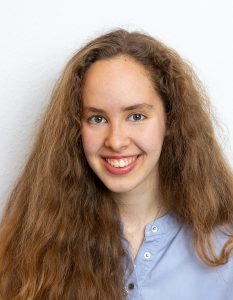
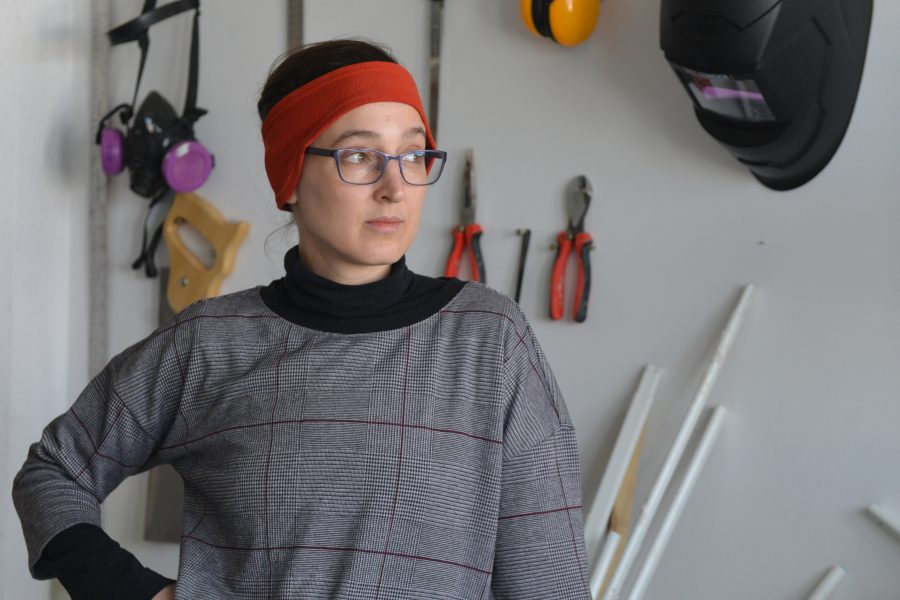
In her latest installation “Remembering Space (how much past can the present hold)”, Noa Heyne, a Berlin-based multidisciplinary artist, deals with notions of maintaining, losing and gaining balance during migration. Her latest work is part of a group show titled “It’s a Balance Trick” (curated by Sophia Pompéry) at the Kommunale Galerie Berlin. The exhibition explores the fragile balance between seemingly conflicting forces, like stability and collapse, individual and society, or memory and the present.
The topic of migration is closely linked to the artist’s own biography. She was born and raised in Israel but decided to leave her home country after witnessing the agressions against Gaza and Palestine.
“Growing up, I became interested in plastic arts by observing my father – an architect – who would frequently draw and build models for his work.” – Noa explains. She soon discovered a passion for making sculptures, which, after studying painting and comparative literature in Jerusalem, led her to the Maryland Institute College of Art, where she received her Master of Fine Arts in 2017.
In the US, Heyne felt part of a great community of young artists but was soon confronted with the socioeconomic and bureaucratic burdens that come with not having a green card. Knowing that she wouldn’t want to live in her home country as the government’s actions are largely in conflict with her values, she decided to move to Berlin the following year.
“I wish my country was a peaceful one”
Heyne explains that she has other Israeli friends in the German capital who emigrated for the same reasons. “However, many people assume that we support Israel” – she remarks.
“I feel uncomfortable with being from Israel, I wish my country was a peaceful one” – the artist adds. Despite the discomfort that this part of her identity causes her, there are many things she misses about her home country. Like many other immigrants, she didn’t move away because she was unhappy in her personal life. Her family, friends, the language, food and weather are things she still reminisces about in her new environment.
Noa feels a strong sense of gratitude for state services in Germany. She feels that there is a generous amount of support for families, which is a crucial aspect for her as a single mother. The thriving art scene in Berlin was also an important pull factor for Heyne back in 2018. However, several crises has led to significant cuts in the culture sector, rendering the financial state of countless artists unstable. The artist shares that “While art was like an escape and a space of freedom for me during my childhood, it is more so tied to practical worries at this stage of my life.” Language barriers and different upbringings are further things that make it difficult for Noa to fully integrate into a new society. Hence, she feels comfortable, but not at home in Berlin.
Losing balance can be a trigger for moving
These struggles go to show that one can be immensely grateful for the opportunities in the country that welcomed them, whilst struggling in many aspects of their new life. This sense of complexity is what Noa intends to bring to the conversation about migration through her installation at the Kommunale Galerie.
“Remembering Space (how much past can the present hold)” explores the interactions between balance and migration. Losing balance can be a trigger for moving, but leaving a home can also lead to the loss of balance. In a new environment, the effort to balance one’s personal identity and the pressure to assimilate takes its toll on the way immigrants carry themselves day to day.
| Making Space Sunday, May 31st, 15:00-17:00 Listening and sharing stories shapes how we relate to one another; How we remember the places we have lived in carries who we were, who we are, and who we try to be when we arrive somewhere new. In this workshop, we will make space for the memories of spaces we have left: we will tell our stories of spatial transitions, which could include migration between countries, but also moving to new cities, changing schools, or leaving homes. Based on these memories, we will build together a collective architectural collage – a three-dimensional representation of our personal histories. Making Space is a joint event by artist Noa Heyne and WahlheYmat, dedicated to strengthening the social and political participation of immigrants in Berlin. Wahlheymat sees participation by people from different countries as a win-win: strengthening belonging while bringing new perspectives that help shape a more inclusive city. The event includes a short presentation of the activity of Wahlheymat in Berlin, followed by a creative workshop led by Noa Heyne. More info here soon. |
To illustrate this nuanced issue, Noa Heyne created an installation that is based on five stories of spatial transitions, within or across countries, told by five women currently living in Berlin. Each woman told a story of a space they left, a journey, and a space they arrived at. During the exhibition period, each month will focus on either one of these categories.
Empathy in and outside the circle of immigrants in Berlin
The artist then created an abstract composition, using materials and forms inspired by the stories told. In the first month, this installation represents the places left. For the second phase, the work is taken apart and reassembled along the wall of the gallery, which is meant to represent the journey. In its third and last month, the installation is once again disassembled and rebuilt to portray the place of arrival. At each phase, the installation is accompanied by an audio recording of the interviewees telling their stories.
The spaces described by the subjects were all tied to specific contexts and sentiments in the environments they left. For instance, some chose to talk about their mother’s study, others about the riverside. Some reported having lost balance after transitioning to a new space, while others felt the opposite.
“This focus on changing abstract spaces instead of geographical places allows for the inclusion of locals, who might have experienced a similar transition due to the relocation of the family or moving away for work” – Noa explains. By making these issues more relatable for the broader society, Heyne hopes to encourage curiosity and foster empathy within and beyond the circle of immigrants in Berlin.
| May 27, 2026, 6 PM – Opening | Kommunale Galerie Berlin | Exhibition: May 28 – September 13, 2026 The group exhibition It’s A Balance Trick – Contemporary Art Between Equilibrium and Instability brings together artists such as Thomas Behling, Anna Borgman, Wiebke Elzel, Catherine Rose Evans, Simon Faithfull, Tom Früchtl, Ya Wen Fu, Noa Heyne, Kennedy & Swan, Csilla Klenyánszky, Nadja Verena Marcin, Gabi Schillig, Natalia Stachon, Morten Straede and Sophia Pompéry, exploring the fragile and dynamic nature of balance through installation, performance, painting, and participatory formats. Rather than presenting equilibrium as a static state, the exhibition unfolds as a constantly shifting system in which works appear, disappear, or transform over time, extending even into the urban space and engaging the audience directly. In doing so, it reflects on balance as an ongoing negotiation between forces—physical, social, and ecological—inviting visitors to experience moments of instability, interaction, and collective alignment. |
(Header image: © Stephen Wilks)