
“Discrimination is not an individual problem, but a structural one”

Michaela Vas,

Multilingualism is not a cultural add-on, but a question of power, participation and democracy — says Remziye Uykun, Project Development and Coordination Lead of the BEFaN Network at Yekmal e.V., in an interview with WahlheYmatPost. She addresses the persistent structural discrimination faced by people with migration histories in Berlin, the marginalisation of Kurdish as a stateless language, and why sustainable, migrant-led networks and reliable funding are essential for educational justice.

WHP: Can you briefly introduce Yekmal? What is your main task in Berlin?

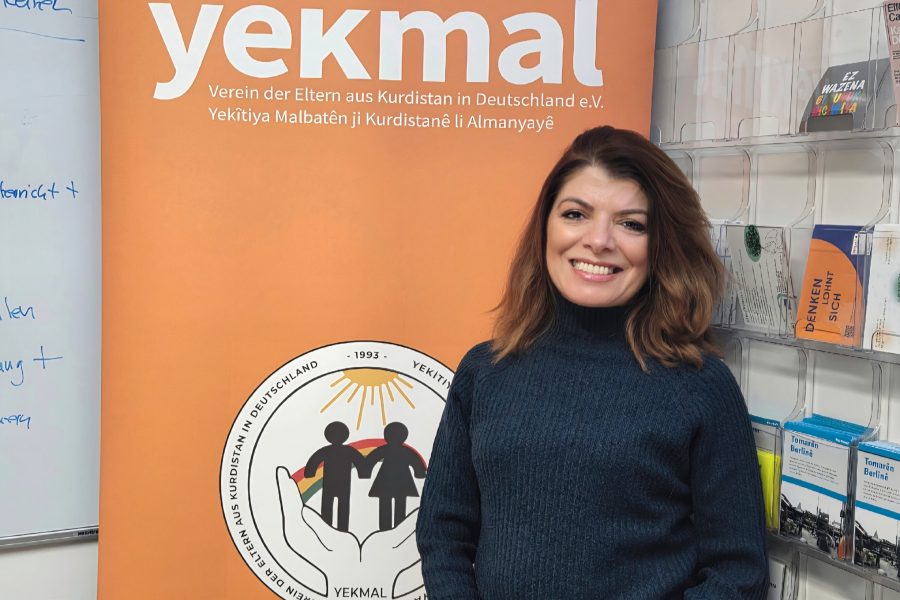
Remziye Uykun: Yekmal e.V. is a migrant education, parent and community organisation based in Berlin that now operates nationwide, with locations in several federal states. Our main task is to strengthen multilingualism as a democratic resource, enable equal participation and structurally anchor anti-racist educational work. Yekmal works at the intersection of families, educational institutions and politics. We advocate for first and family languages to be not only symbolically recognised but concretely supported – in daycare centres, schools and extracurricular educational spaces.

We explicitly understand education as a question of power and justice: it is about whose language counts, whose knowledge is recognised, and who is allowed to participate in decision-making.

A particular focus of our work lies on institutionally marginalised languages such as Kurdish as a stateless language. The lack of structural support is not a pedagogical oversight, but an expression of political decisions and anti-Kurdish racism. Our goal is an education system that does not merely manage diversity, but understands it as the foundation of democracy and social justice.

WHP: What personally motivated you to get involved here?

Remziye Uykun: The migration policy perspective is decisive for me. I bring many years of experience in this field and represent a clear position: education, participation and democracy cannot be conceived without the consistent inclusion of people with a migration history.

Multilingualism, participation and educational justice are not abstract guiding concepts for me, but concrete political tasks. Too often, they are named without being structurally implemented. Yekmal offers me the space to address these issues in a practical, political way, together with the communities, and in an effective manner.

What motivates me is the conviction that sustainable change can only succeed if people with a migration history do not remain objects of measures, but are recognised and involved as acting subjects.

WHP: What challenges do people with a migration history face in Berlin – and how does your organisation deal with them?

Remziye Uykun: People with a migration history in Berlin continue to face structural mechanisms of exclusion and institutional discrimination. These are particularly evident in the education system, but also in access to participation, recognition and funding. As a Kurdish parents’ association, Yekmal is often subject to a general suspicion that directly affects cooperation, institutional recognition and project funding. As a Kurdish organisation, we have to legitimise ourselves far more than others. This is not an isolated case, but an expression of anti-Kurdish racism and structurally unequal treatment.

These exclusions have a direct impact on children. Kurdish children experience discrimination in schools, for example through the devaluation of their language, the lack of first-language support, or low institutional expectations. The fact that Kurdish is a stateless language further exacerbates this disadvantage.

Yekmal addresses these challenges through empowerment and educational work, professional qualification, parental counselling as well as political and professional intervention. Our approach is clear: discrimination is not an individual problem, but a structural one – and must also be addressed structurally.

WHP: Is there a project, event, or initiative coming up that you would particularly like to recommend to our readers?

Remziye Uykun: Two initiatives stand as exemplary for our work: the BEFaN network and the WIRKT! project. BEFaN is a Berlin-wide professional network of 27 migrant organisations that has existed for over ten years and works to promote the institutional anchoring and support of multilingualism, participation, diversity, and educational justice in the education system. Despite its high relevance for democracy policy, BEFaN is still largely dependent on voluntary work and is not sustainably financially secure.

The WIRKT! project is specifically aimed at parents with a migration history and strengthens parental participation and involvement, particularly in parent committees. WIRKT! combines empowerment, political education and networking with the aim of enabling parents to effectively represent their interests and actively shape educational processes.

Both initiatives clearly demonstrate that participation, diversity and democracy do not emerge on their own – they require committed migrant-led structures and reliable funding.

WHP: How can interested people support your work or get involved themselves?

Remziye Uykun: Support begins with not only recognising migrant perspectives, but actively including them. Interested people can support our work by participating in events, getting involved in projects, entering into cooperations, or making our positions visible in public and political spheres.

What is crucial here is a shared understanding that participation is not a voluntary concession, but a democratic right that must be politically intended, institutionally enabled, and permanently structurally secured.

Remziye Uykun is a qualified sociologist. Since 2024, she has been working at Yekmal e.V., where she coordinates the Berlin-wide professional network BEFaN and is responsible for project development. For many years, she has been committed to the institutional recognition of multilingualism, strengthening migrant-led organisations, and advancing educational justice and equal participation.

Author:

More From WahlheYmatPost

  • Berlin Wiki: Party Profiles II – The Greens, The Left, the AfD and the BSW party

    Berlin Wiki: Party Profiles II – The Greens, The Left, the AfD and the BSW party

    What is the Green Party? Bündnis 90/Die Grünen is an important political force in the Berlin House of Representatives. Although the party has not been part of the government since the 2023 election, it operates from the opposition within parliament. Its guiding principle is ecological, economic, and social sustainability. It focuses on stronger climate protection,…

  • Berlin Wiki: Which Parties Shape the Capital?

    Berlin Wiki: Which Parties Shape the Capital?

    Which parties are important in Berlin? Berlin has many political parties, each pursuing its own agenda. These parties are organized at different levels. Many have a Berlin state association, as well as several district and local branches. The parties that receive the most votes form parliamentary groups in the House of Representatives, Berlin’s parliament. The…

  • The Good, the Bad, and the Arbeitsamt

    The Good, the Bad, and the Arbeitsamt

      Most places have an arm of the government to help folks out when they’re unemployed; governments like their citizens to have jobs and pay taxes. It tends to keep the governments – and the citizens – happy. There’s also the matter of not letting people starve in the street when they’re out of work.…

  • Home Is Not a Place: A Berlin Exhibition Rethinks Migration

    Home Is Not a Place: A Berlin Exhibition Rethinks Migration

    How do people change after moving from one place to another? What do they leave behind and what do they carry with them? Is it possible to feel at home in a space that is vastly different from the one we left? In her latest installation “Remembering Space (how much past can the present hold)”,…

  • Berlin Wiki: Your Guide to the 2026 Berlin Election

    Berlin Wiki: Your Guide to the 2026 Berlin Election

    What will be elected in Berlin in 2026? On September 20, 2026, a new House of Representatives will be elected in Berlin. At the same time, the district assemblies of Berlin’s twelve districts will also be elected. The electoral term is always five years. Voters therefore decide which parties and politicians will serve in these…

  • Multilingualism, Participation, and Power: A Berlin Case Study

    Multilingualism, Participation, and Power: A Berlin Case Study

    Local migrant organizations often play a crucial yet underrecognized role in shaping participation, representation, and social cohesion within urban districts. Based on my experience directing the migraUp! Pankow project in Berlin between 2015 and 2025, this reflection highlights how community-based initiatives can strengthen migrant organizations while simultaneously contributing to local governance and democratic participation. migraUp!…

  • “Democracy Is More Than Voting”: Sami Atris on Organising Communities in Berlin

    “Democracy Is More Than Voting”: Sami Atris on Organising Communities in Berlin

    WHP: Can you briefly introduce the Berliner Bürgerplattformen? What is its main purpose in Berlin? Sami Atris: Who actually decides what happens in our lives? How much influence do we have over how high our rent is — or whether we can even afford to stay in our neighbourhood? Who decides whether our children go…

  • “Das Volk” in 2026: Time to Redefine the People

    “Das Volk” in 2026: Time to Redefine the People

    “Do you behave as the person you truly want to be?” I ask myself this question in moments when I clearly fall short. Yes, it is hard to live up to one’s ideal self—I’m probably not the only one who feels this way. The same applies for societies. Over the past ten years, I have…

  • “Treat Every Case as Your Own”: How Zaki e.V. Supports Berlin’s Overlooked Migrants

    “Treat Every Case as Your Own”: How Zaki e.V. Supports Berlin’s Overlooked Migrants

    WHP: Can you briefly introduce Zaki e.V.? What is your main mission in Berlin? Pia Bergmann: Zaki – Bildung und Kultur e.V. is a migrant-led organization, with its main office located at the Berlin Global Village in Neukölln and another office in Pankow. The organization’s focus can be summed up in one sentence: arrival and…

  • Germany Has an Energy Crisis — Just Not the One You Think

    Germany Has an Energy Crisis — Just Not the One You Think

    Energy – scarcity.We talk about energy all the time—but only in physical terms.I find myself thinking more and more about our social energy, which may matter even more. Because a society also needs energy. This energy, I would call social energy—a concept that appears in the social sciences under terms like collective intelligence or social…

  • One In Four Berliners Cannot Vote: Europe Still Struggles With Migrant Political Participation

    One In Four Berliners Cannot Vote: Europe Still Struggles With Migrant Political Participation

    A recent report by the Migration Policy Group, a think tank based in Brussels, shows that Germany is among the best of the worst when it comes to enabling and encouraging the political participation of immigrants. Germany’s score in this is only a small part of the bleak findings from the report’s Political Participation Index,…

  • ‘Migrants’ Are The Greatest Opportunity For Germany

    ‘Migrants’ Are The Greatest Opportunity For Germany

    “Change begins with a conversation.” That’s why I was glad to be invited to the SharedTableDinner by the Oneliness Project. How do we find a sense of home in each other? How are loneliness and democracy connected? These were the questions that shaped the evening. Amazing people shared deeply personal thoughts about how they connect…

  • Ukrainian Voices in Berlin: “People Are Not Objects for Integration Debates”

    Ukrainian Voices in Berlin: “People Are Not Objects for Integration Debates”

    WHP: Can you briefly introduce the Allianz Ukrainischer Organisationen e.V (Alliance of Ukrainian Organizations)? What is its main task in Berlin? Oleksandra Bienert: The Allianz Ukrainischer Organisationen e.V. is a nationwide association currently bringing together 23 civil society organizations in eight federal states. These organizations were founded by people with a Ukrainian migration background and…

  • WahlheYmat Turns Two — And Invites You In

    WahlheYmat Turns Two — And Invites You In

    WahlheYmat is looking for new members.That is the message I would like to write about today. Before my life in Berlin, I was never this direct. I am learning a lot here. And I don’t just mean the famous Berliner Schnauze — like going into a bakery and saying: “Good morning, so sorry for disturbing…

  • The Berlin Blueprint: Participation as the Ultimate Act of Self-Determination

    The Berlin Blueprint: Participation as the Ultimate Act of Self-Determination

    In the glossy catalogs of modern wellness, “self-help” is often sold as a retreat from the world: a private journey of healing through products and quiet contemplation. Berlin’s history, however, offers a more rugged, democratic alternative. In this city, wellbeing has never been found in isolation. It has been forged through participation. To be a…

Address

Am Hamburger Bahnhof 3
10557 Berlin
Germany

hey@wahlheymat.de

Social Networks