
WHP: Can you briefly introduce your organization? What is its main task in Berlin?
Dr. Kamila Schöll-Mazurek: The Polnischer Sozialrat (Polish Social Council – PSR) is one of the oldest Polish migrant organizations in Germany. Since our founding in 1982, we have advocated for the social participation and equal rights of Polish people in Berlin. What began as an initiative to support Polish migrants has, over the years, developed into a nationally active organization. Today, we advise and assist people from Central, Southern, and Eastern Europe who live and work in Germany.
Our main task is to offer social counseling and empowerment – especially for EU citizens with a history of migration. We support them with questions about work, housing, social benefits or residence, while politically advocating for their rights. In doing so, we work closely with Berlin authorities, other migrant organizations and networks to advance the diversity-oriented opening of public services.
As co-founders of the Migration Council Berlin (Migrationsrat Berlin e.V.) and the Polyphon Network for Migrant Voices, we are also actively engaged in urban political processes. Together with other communities in Berlin, we stand up for equal treatment, solidarity, and more visibility of migrant perspectives. We conduct over 3,000 consultations annually – and see ourselves as a bridge between the communities and the city’s institutions.
WHP: What personally motivated you to get involved?
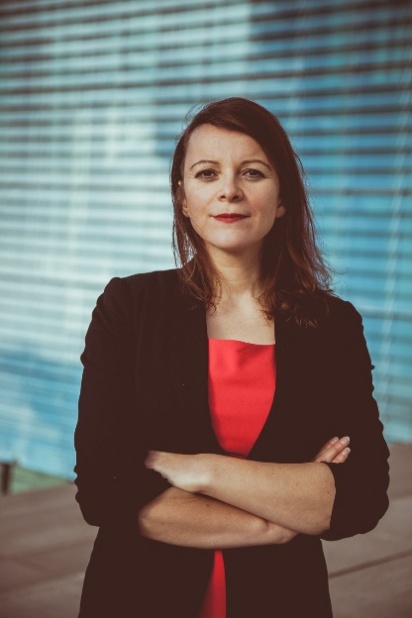
Dr. Kamila Schöll-Mazurek: I myself come from a region on the border with Ukraine – an area where there were few opportunities to engage socially or politically. When I came to Berlin, I suddenly saw how many opportunities there are here to get involved. Perhaps I’m simply making up now for what I lacked before.
Even back then, it was clear to me that the fate of those who are excluded or overlooked is very close to my heart. Berlin is a city of great contrasts, and it is precisely here that I see enormous potential, but also many inequalities. That’s why I’m engaged in precisely this area – for more participation, equal rights, and visibility.
As a young woman, I was fortunate to be able to take part in many educational and scholarship programs – in Germany and beyond. These experiences shaped my creativity, my approach to projects, and my sense of social responsibility. Today I can pass on this knowledge. It is a great gift to work in a field where you can find personal fulfillment and at the same time contribute to social change and the strengthening of democracy.
Another important motivation is my perspective as an EU citizen. I see a large gap in public discourse regarding the Europeans living in Germany. They make up almost half of Germany’s 25% migrant population – and yet they are rarely talked about. I want their voices to be heard, their stories to become visible.
I am a person who loves change – also from a scientific perspective. For years I researched social transformation processes. At some point I no longer wanted just to observe, but to act: to put the findings from research directly into practice.
My current work, in which I am strategically active in a cooperative project (“Kooperationsverbund für Vielfalt und Zusammenhalt: Chancengerechtigkeit in der pluralen Gesellschaft“), gives me exactly this opportunity. I can work on concepts and strategies that lead to real societal change – to a more positive perception of migrants in Germany and especially in Berlin.
And finally, I am also motivated by the situation of many Polish people here in Berlin. Many of them work far below their qualifications. There is so much potential and at the same time such a lack of visibility. I want to make a difference for these people – and I am grateful that I can do exactly that.
WHP: What challenges do people with a migration background face in Berlin – and how does your organization deal with them?
Dr. Kamila Schöll-Mazurek: Our target group consists primarily of EU citizens from Eastern Europe. In everyday life, we are constantly confronted with various forms of exclusion and disadvantage, which often arise from excessive bureaucracy and complicated administrative procedures.
Our organization’s response to these challenges – and this has been the case for many years – is migration counseling.
We offer support for people at risk of social exclusion and help them navigate Berlin’s complex structures. In this way, we promote participation, equal opportunities, and self-determination.
In addition, we carry out projects in the area of social cohesion. In doing so, we respond to the growing tensions and contradictions between the awareness of how much migrants contribute to Berlin’s prosperity and the simultaneous tendency to blame them for political or social problems.
We address these developments through mentoring programs, cooperation with refugees, and through our advocacy work. Especially after the recent statements by Mr. Merz, it has become clear how easily society can become polarized – and this is exactly where we come in.
Our goal can be summarized in two ways: On the one hand, we want to improve the situation of EU citizens from Eastern Europe through counseling, advocacy, and social media. On the other hand, we want to contribute to better coexistence and a positive image of migration in Berlin.
We cooperate with numerous institutions and see ourselves as a bridge between Polish migrants – their knowledge, their needs and challenges – and the German authorities, as well as political decision-makers.
WHP: Do you have a project, event, or initiative coming up that you would like to recommend to our readers?
Dr. Kamila Schöll-Mazurek: Our model project, “Migration Social Services”, in Berlin is a very exciting and dynamic undertaking. Within the framework of this project, five counselors are working, and thanks to the funding from the Senate Department for Labor, Social Affairs, Equality, Integration, Diversity and Anti-Discrimination, as well as the Berlin Senate Commissioner for Participation, Integration and Migration, the project can continue to develop.
Currently, we also have a counseling center in Charlottenburg that specifically provides services for Polish migrants – a group that has so far been underrepresented in Berlin’s migration landscape, especially in comparison to their actual numbers in the city and the state of Berlin.
Another particularly interesting project is our “Mentorship Program,” in which mentoring pairs share their knowledge, experience, and networks. Through this personal accompaniment, we promote mutual learning, integration, and empowerment – and create bridges between people of different origins. Financed from funds of the Federal Ministry of Education, Family Affairs, Senior Citizens, Women and Youth.
WHP: How can interested people support your work or participate themselves?
Dr. Kamila Schöll-Mazurek: There are many ways to support the Polish Social Council or become part of our work. The most direct way is through membership. As a member, you help ensure that the voices of EU migrants – especially from Central and Eastern Europe – are heard in Berlin. You support our political and social work, with which we advocate for equal treatment, integration, and the strengthening of migrant communities. At the same time, you yourself benefit from a strong network, access to counseling, workshops, and further educational opportunities.
Those who prefer to participate in projects or volunteer work are also very welcome. Our volunteers contribute their experience, ideas, and skills to language courses, workshops, or counseling services – or develop their own initiatives that we are happy to support. Together we create spaces for empowerment, dialogue, and acting in solidarity.
And of course, we are also happy to receive donations or supporting memberships. They enable us to continue our work independently – from counseling services to events to political engagement for more equal opportunities.
All information about membership, donations, and volunteer involvement can be found on our website: www.polskarada.de