
The Kiez: Where Berlin Becomes Personal

By
Berlin Kreuzberg Kiez
Berliners love to talk about their Kiez — a word that means much more than just “neighborhood.” It’s a slice of the city that feels like home, defined not by borders on a map but by the places and people you know by heart. Walter Phippeny explores what makes the Kiez such a deeply personal part of Berlin life.

I’ve often said that in France every region has its dish, its wine, and its cheese; in Germany, every region has its dish, beer, sausage…and language. If we learned German before coming here, we learned “High German” (Hochdeutsch) – because it’s spoken in the high country… not because it’s lofty, or something – and then we landed in the country and we soon found ourselves confronted with dialect. 

I’ve heard that other countries, like Italy, also have very different dialects, but I haven’t experienced that firsthand. A dialect is not a different language but it has its own accent and vocabulary. We don’t really have anything like it in the US – Germans will often point to the Deep South for dialect, but it’s not really dialect, just accent. Still, from dialects we get these interesting words, giving each region its own flavor. “Kiez” is one of those words. 

It’s a neighborhood

The word Kiez, though, is not originally German. It’s a loanword from one of the slavic languages that used to be spoken by the original inhabitants of the Northeast, like the name “Berlin” itself. It probably comes from “chysa” or “hyža”, meaning hut or fishermen’s hut. Originally, it referred to an inhabited area that would provide goods and services to a local castle or fortification and it goes all the way back to the Middle Ages. I’ve heard that Kiez is used throughout the Northeast, but, aside from Usedom, I haven’t spent much time there and couldn’t say for sure. 

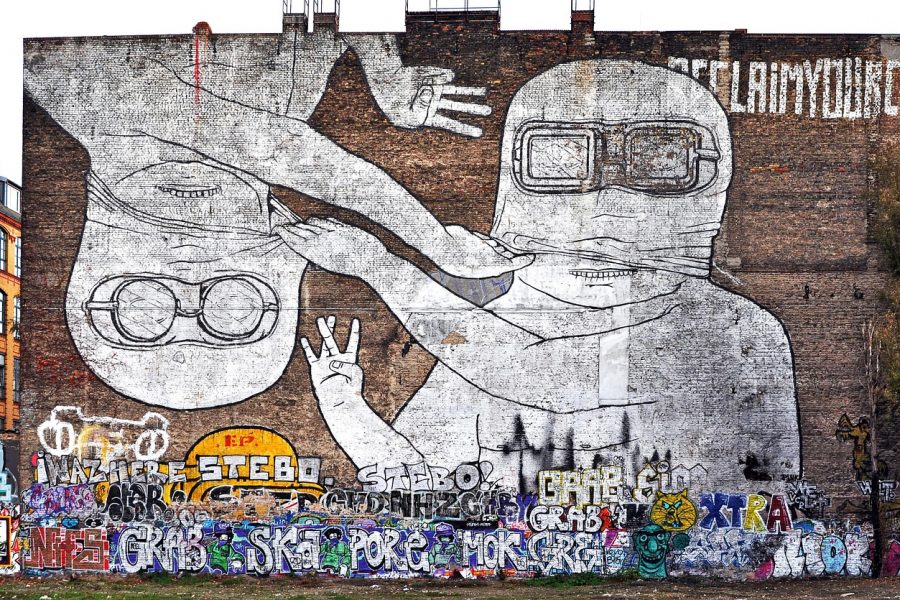
East Side Gallery

The idea of a Kiez exists in just about every urban center. Traditional Cockney in London is a Kiez: folks who grew up within earshot of the Bow Bells. Paris has the idea of an arrondissement. It’s a neighborhood – The place where you spend most of your time, do all your shopping, where you have your local, where people know your name. 

“A Kiez is something personal and intimate”

I’ve had Berliners explain it even a little further to say specifically that your Kiez is everything within easy walking distance from your house. It’s different from a quarter or a district; I live in Prenzlauer Berg, but that’s not my Kiez. Prenzlauer Berg is too big to be a Kiez. 

No, my Kiez is the Rewe I go to and the guy who works behind the deli counter who is always friendly, and, surprisingly, always in a good mood; my Kiez is my local and the bar keep who is already pouring my drink before I sit down on the stool; my Kiez is my barber shop where everyone calls out my name when I walk through the door. My Kiez are all my neighbors in my apartment building and the chats that we have on the stairs. A Kiez is something personal and intimate even when city living can be so anonymous. 

Walk your Kiez

You’ll hear people throwing the word Kiez around a lot, trying to show their Berlin cred; it’s probably one of the first words in Berlinerisch that you’ll pick up next to “jut” and “schön jewesen”. I’ve seen comedy sketches making fun of people from Schwabenland, peppering their small talk with it. But the more you live with it, the more it DOES become a part of you, just like all the other little Berlin bits that leave their mark. Rather than a social cue, showing off how well you’ve integrated into the city, it becomes a much more tangible thing. It starts to become part of you. 

So, walk your Kiez, get to know it, and get to know the people who live in it. Go back to the same places and get to know the people who work there, live there, play there. It’s worth your time.      
Author:

More From WahlheYmatPost

  • Stay: The New Migration Challenge Germany Can’t Ignore

    Stay: The New Migration Challenge Germany Can’t Ignore

    If nothing changes demographically, Germany will have 16 million fewer workers by 2060 than today. According to most projections, the country needs around 400,000 new workers every year from abroad. We often hear this fact in the news, but what we hear much less about is how many international people leave Germany again—and this seems…

  • “We Can’t Let Protection Become a Privilege”

    “We Can’t Let Protection Become a Privilege”

    WahlheYmatPost: Can you briefly introduce your organization? What is its main mission in Berlin? Vicky Germain: The Migrationsrat Berlin e.V. (Migration Council Berlin) is an umbrella organization of more than 90 BIPoC (Black, Indigenous, and People of Color) and/or migrant self-organizations and post-migrant groups in Berlin. Its central mission is to improve the social, political,…

  • Neustart Berlin: A Fresh Start Without Everyone in the Room

    Neustart Berlin: A Fresh Start Without Everyone in the Room

    Berliner Morgenpost — together with Tagesspiegel, EUREF Campus, and radioeins — launched a strong new initiative: Neustart Berlin. Everyone was invited to submit an ongoing project that could revitalize Berlin and give the city a fresh start for the 21st century and beyond. More than 70 initiatives applied; a jury selected eight of them to…

  • Berlin, Hold My Book: Why Physical Still Beats Digital

    Berlin, Hold My Book: Why Physical Still Beats Digital

    Ok. This is going to sound like a typical “back in my day” kind of old man rant. But hear me out, because I’m not talking about a world swallowed by time. Despite claims to the contrary, Berlin is still full of places that offer a key to a door that still stands today: a…

  • Remembering as Resistance – How AKEBI Confronts Racism in Berlin

    Remembering as Resistance – How AKEBI Confronts Racism in Berlin

    WahlheYmatPost: Can you briefly introduce your organization? What is its main mission in Berlin? Erkin Erdoğan: AKEBI e.V. is a Berlin-based non-profit association, founded by migrants from Turkey in 2014. The name “AKEBI” is the acronym of “Association of Activists Against Racism, Nationalism, and Discrimination” from the Turkish language. We had a preceding anti-racist network…

  • The Berlin Lesson: Trust People, Not Bureaucracies

    The Berlin Lesson: Trust People, Not Bureaucracies

    I was reading Walter’s article about volunteering, and made me think deeply. I come from a society where volunteering was never a tradition. The imperative was: everyone takes care of themselves. If someone works unpaid, they are considered a loser or being taken advantage of. Applying to university never required any kind of volunteer experience,…

  • How Audrey Tang Is Rebooting Democracy — and What Berlin Can Learn from Taiwan

    How Audrey Tang Is Rebooting Democracy — and What Berlin Can Learn from Taiwan

    “The engine behind reshaping democracy has been young people and immigrants,” Audrey Tang – Taiwan’s Cyber Ambassador and first Digital Minister – told me. I was fortunate enough to meet Audrey at the Berlin Freedom Conference on 10 November. To tell you the truth: Audrey was the main reason I went. Ever since I read…

  • From Glitter to Growth: How Taylor Coburn Found Her Shine in Berlin

    From Glitter to Growth: How Taylor Coburn Found Her Shine in Berlin

    I had the pleasure of sitting down with an immigrant change-maker who encourages fellow immigrants from all walks of life to build their lives here in Berlin, instead of just scraping by and letting social norms, visas, or rules rob them of their ability to thrive.  Taylor Coburn is involved in many projects around the…

  • The Power of Ehrenamt: Finding Connection Through Volunteering in Berlin

    The Power of Ehrenamt: Finding Connection Through Volunteering in Berlin

    The news is grim these days. Everywhere we look things are going off the rails. The cost of living, and the political maneuverings… everything seems like too much, too soon, and too fast. And it’s easy to give in to the atomization of 21st century life; we are millions of people living alone. Alone in…

  • Giving Voice to Eastern European Migrants: The Polnischer Sozialrat’s Work for Equality

    Giving Voice to Eastern European Migrants: The Polnischer Sozialrat’s Work for Equality

    WHP: Can you briefly introduce your organization? What is its main task in Berlin? Dr. Kamila Schöll-Mazurek: The Polnischer Sozialrat (Polish Social Council – PSR) is one of the oldest Polish migrant organizations in Germany. Since our founding in 1982, we have advocated for the social participation and equal rights of Polish people in Berlin.…

  • Six Pictures from the Future — A Glimpse into Tomorrow’s Berlin

    Six Pictures from the Future — A Glimpse into Tomorrow’s Berlin

    For a campaign, you need many elements — but everything starts with funding. That’s why we first want to give enormous thanks to the supporters of WahlheYmatPost, to everyone who believes in what we do and why we do it: the Welcome Alliance Fund by ProjectTogether and the Bundesministerium des Inneren. And a heartfelt thank-you…

  • “Berlin Modern” — Is This the Modern Berlin?

    “Berlin Modern” — Is This the Modern Berlin?

    Last weekend, I had the chance to see inside Berlin’s newest museum: Berlin Modern.The visit made me think about how we imagine the future Berlin. If you’ve walked near the Kulturforum, between the Neue Nationalgalerie and the Philharmonie, you’ve surely noticed that enormous construction site. That is where Berlin Modern is rising — a new…

  • Welcome to the Club: How Vereine Can Turn Berlin from a City of Strangers into a Home

    Welcome to the Club: How Vereine Can Turn Berlin from a City of Strangers into a Home

    In 2000 Robert D. Putnam published a book, “Bowling Alone”, in which he argued that Americans were becoming increasingly isolated and removed from community and social capital. He took the institution of the Bowling League as his prime example. I remember when the book came out – though, admittedly, I never got around to reading…

  • “Civil Courage Begins in Everyday Life – and Ends Where We Look Away” – Diana Henniges on 12 Years of Moabit hilft

    “Civil Courage Begins in Everyday Life – and Ends Where We Look Away” – Diana Henniges on 12 Years of Moabit hilft

    WHP: Can you briefly introduce your organization? What is its main mission in Berlin? Diana Henniges: Moabit hilft e.V. is an independent, civil society association that emerged in 2013 from a spontaneous neighborhood initiative. We support people in urgent need – whether they are refugees, have a migration background, or need help for entirely different…

  • Bürgerbeteiligung: Participation or Paperwork?

    Bürgerbeteiligung: Participation or Paperwork?

    Berlin invites its citizens to participate — but only after the decisions are made. A visit to the Bürgerbeteiligungsbüro: where good intentions meet German bureaucracy. I was so happy when I first discovered the Bürgerbeteiligungsbüro. Yes! Finally, a place for participation! It took me quite some time, though, to understand what this institution is actually…

Address

Am Hamburger Bahnhof 3
10557 Berlin
Germany

hey@wahlheymat.de

Social Networks