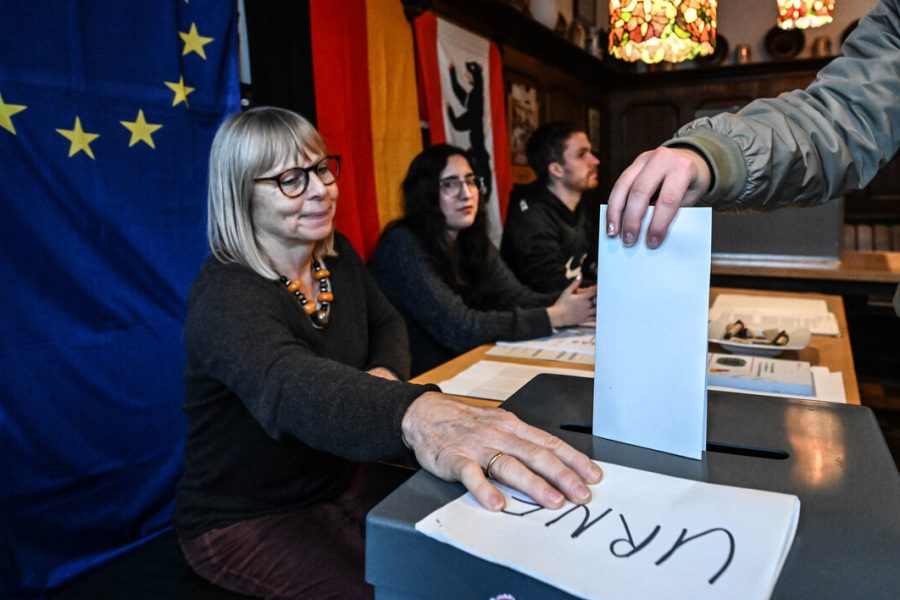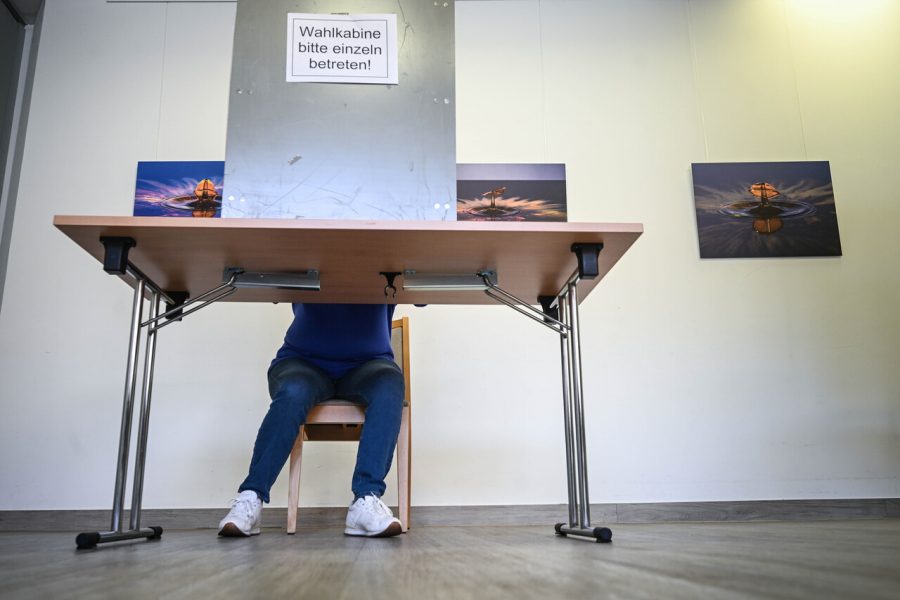

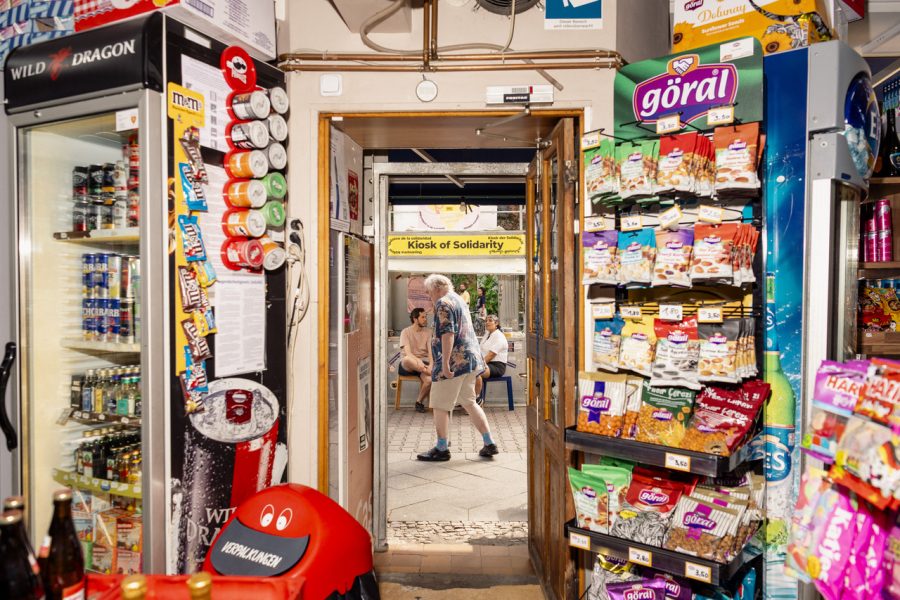
Ahead of Berlin’s September elections, Migrationsrat Berlin e.V. brought the ballot box to an unusual setting: the city’s Spätis. At 11 locations across Berlin, people were invited to take part in a symbolic election and discuss a question that affects a significant part of the city’s population: who gets to have a say in the political decisions that shape their everyday lives?
The initiative was organised as part of the PASSt uns allen coalition, in cooperation with Sonntag ist Spätitag, Berliner Späti e.V., Migrationsrat Berlin e.V. and moveGlobal e.V. It aimed not only to make the political views of people without voting rights more visible, but also to create conversations in places that are part of everyday neighbourhood life. The experience revealed more than voting preferences: it showed how differently Berliners relate to elections, how little some know about who can and cannot vote, and how informal spaces can become places of political participation.
To look back at the symbolic election and what emerged from it, WahlheYmatPost spoke with Mallika Basu, Policy Advisor for Participation at Migrationsrat Berlin e.V. and coordinator of the coalition PASSt uns allen, and Maria Vittoria Celardo, a student at Bard College Berlin and intern at Migrationsrat Berlin e.V.
WHP: What was the original idea behind the symbolic election, and why did you choose Berlin’s Spätis specifically as the voting locations?
Mallika Basu: The original idea behind holding symbolic elections at the Spätis was to anchor the campaign in something immediately recognizable and meaningful to people in their everyday lives, and Berlin’s Spätis are exactly that. They are important meeting points for people of all social classes and ages, as they offer cheaper and more accessible alternatives for hanging out and meeting friends or family.
Spätis in Berlin are mostly run by migrants and/or BPoCs and are therefore often safer places for BPoCs, where they feel comfortable and welcome. Many people know the owners and staff of their neighbourhood Spätis and have a good and friendly relationship with them. They are highly politicised places but are rarely seen as such, which is exactly why we wanted to bring a political subject to them. They are also the perfect place to start conversations with people about our work, as people tend to stay a while and are not in a rush.
Maria Vittoria Celardo: That everyday trust is really what made the whole concept work and, thinking about it more, it connects to something bigger too. The places where the state normally tries to build trust with its citizens – polling stations, town halls, government offices – are exactly the places many of the people we spoke to have historically never had access to.
Going to the Späti instead meant reaching people through trust that already existed, rather than expecting them to trust an institution that had never given them a reason to. Trust doesn’t have to start in a government building; it can start somewhere much more ordinary. And that says something real about where democratic participation could actually be built from.
WHP: What’s your assessment after the symbolic election? Who took part, and how was the initiative received?
Malika Basu: This was our first time cooperating with Spätis and also the first time we held symbolic elections, so there was a lot we were learning as we went. It was carried out at 11 different locations all over Berlin, and the reactions and conversations were really different from Bezirk to Bezirk, which was interesting in itself.
Not that many people actually filled out the symbolic election form, but a lot of them were very interested in sharing their stories, experiences and knowledge. Some were worried or unsure about filling it out, and a few mentioned that because they can’t vote anyway, they’d genuinely never thought much about the parties or who they might vote for. A lot of the people who do have voting rights weren’t well informed either; they had no idea how many people in Germany can’t vote, and were pretty shocked when we told them.
Maria Vittoria Celardo: Looking at the actual numbers behind this: 285 people answered the general Wahlrecht question, but only 149 went all the way and filled out the full symbolic ballot with actual party choices. That’s a real gap – roughly half – and it lines up with exactly what we were seeing on the ground: people were much more willing to talk, share an opinion, or say “yes, this matters to me,” than to actually sit down and commit to something closer to a real vote. So the setting made that first step easy, but it couldn’t fully close the gap to the second. And if you think about it, that mirrors how voting rights themselves work: having an opinion is accessible to everyone, but the actual, formal act of voting is exactly what’s being withheld from the people we spoke to.
Malika Basu: All in all, we found it a really valuable event. We got to hear people’s perspectives and educate a few others along the way. Plenty of people told us they were glad we did this, that they thought it mattered, and that more things like it should happen. We talked to a lot of people who wanted to understand our reasoning behind the demands, and also to many people who were born and raised in Berlin and still aren’t allowed to vote.
WHP: What reactions and conversations from the events have stayed with you? Was there anything that surprised you?
Mallika Basu: A lot of 16- and 17-year-olds didn’t know they could vote in the September elections in Berlin, which really surprised us. It made us wonder why schools or local governments never inform young people about this. It’s the same story with a lot of the institutional spaces people are supposed to be informed through, schools, government offices, that sort of thing. They’re exactly the places that failed these teenagers here.
The information about their voting rights should have come from there, and it just didn’t, which says something about how informal spaces like Spätis ended up stepping in to cover the shortfall left by these bigger institutional spaces.
It’s also always jarring to hear the stories of people who were either born in Germany or have lived here for most of their lives, and the struggles and injustices they deal with every day. A lot of them are really politically active and frustrated with the state of things in Germany and the world more broadly. Political decisions shape their everyday lives enormously, and they want to be seen as equals – to have the same rights as everyone else. Housing kept coming up too: how unaffordable it’s become in Berlin, and how they wish every party would actually take that seriously.
WHP: What did you learn through the symbolic election about how people without voting rights perceive their political situation in Berlin?
Maria Vittoria Celardo: We saw a lot of frustration and anger. Voting is one of the most important pillars of democracy, and to be denied that is very worrying for many Berliners. We also got to know a lot of the different ways people without voting rights participate in politics and how their activism is also shaped by the inability to vote.
WHP: A symbolic election can’t replace a real one. What can an initiative like this still achieve, and where are its limits?
Mallika Basu: A symbolic election obviously can’t replace a real one, but that doesn’t mean it can’t do something real. Think about the story of the teenagers who didn’t know they could vote: that’s institutional spaces failing people. Schools and government offices – the places that are supposed to actually reach people with this kind of information – simply don’t.
An informal space like a Späti can step into that gap, but only up to a point. A conversation at a counter can inform someone, or raise an issue that wasn’t being discussed before, but it is not a place where you can officially vote and it can’t fix the structural reasons why people were never told about their rights in the first place. That’s the honest limit. What it can do is shift awareness and start conversations that wouldn’t otherwise happen.
Maria Vittoria Celardo: Our main goal was to speak to Berliners, to have a low-key, informal exchange about discrimination, human rights and justice. We wanted to talk about how political decisions shape lives, and why democratic countries should actually include everyone regardless of citizenship or legal status. Holding it at Spätis, such public and everyday spaces, meant reaching people who aren’t necessarily connected to political organisations, such as NGOs, non-profits, and grassroots organisations.
And sharing the perspectives of people without voting rights with the wider public matters on its own. It shifts the conversation and makes others more aware of the realities of the people living in this city. You can’t vote people into having rights through a symbolic election, but you can make the people who already have those rights aware enough to start asking why others don’t.
WHP: If you could take away one central message from the symbolic election to send to Berlin’s politicians, what would it be?
Maria Vittoria Celardo: Voting rights for everyone who has lived in Germany for three years are long overdue. It’s nothing outlandish; many countries already have these structures in place. Politicians have often said it’s too difficult from a legal perspective, but other countries have shown us that it isn’t. Which makes the excuse “it’s too difficult legally” sound a lot less like a fact, and a lot more like a choice that nobody in politics really wants to own.
Mallika Basu: If Berlin actually calls itself a democracy, it can’t keep hiding behind this defense to justify excluding people who live here from having any say in how the city is run. Equal rights should be fought for, no matter how difficult the process is.
(Header image: © Jeremy Knowles)