
Are degrees really the only measure of knowledge? Should humans focus on altering nature or adapting to it? Do international studies actually include perspectives from all around the world? Academic credentials, adapting nature to suit modern lifestyles and Eurocentric education are standards that are rarely questioned.
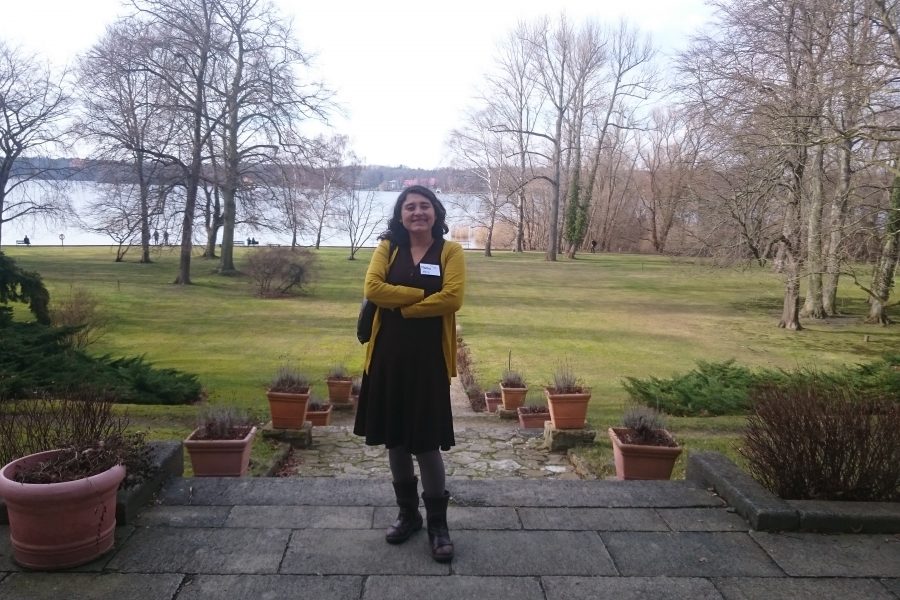
Marita Orbegoso Alvarez, Peruvian educator, community organizer and activist, made it her mission to spark dialogue about the traces of colonialism and the effects of Eurocentrism on Western and non-Western societies.
Her non-profit association “MigrArte Perú e.V.” brings Indigenous voices to the conversation about modern-day challenges. Integrating different perspectives has always been a defining aspect of Orbegoso Alvarez’s work, enabling her to create tangible change across different areas. Working from Europe, she does not claim to represent those communities. Rather, the goal is to create spaces where these issues—and the ways in which they are discussed and understood—can become part of the public agenda.
Grassroots Activism in Northern Peru
Marita Orbegoso Alvarez was born in Lima into a large, working-class family with roots in Cajamarca, a region in northern Peru. Growing up, she witnessed the impact of grassroots movements in the fight for social justice, sparking her interest in political activism at an early age. Soon after completing her studies in pedagogy and literature, she immersed herself in the world of community organizing.
As a young woman, Marita was shaped by the principles of liberation theology, founded by Father Gustavo Gutiérrez, and by her participation in UNEC (the National Union of Catholic Students). These experiences helped shape her conviction that faith must be lived through action and that spirituality and political engagement are not mutually exclusive. Instead, both can serve as powerful tools for challenging injustice, advancing social transformation, and fostering a more equitable society.
One of her early projects, facilitated by the regional Christian congregation, involved advising Indigenous women in the textile industry on how to escape the fast-fashion industry.
Having studied literature at university, Orbegoso Alvarez had acquired a basic knowledge of Quechua (Chanca), which helped her establish meaningful communication with Indigenous women in Cusco. The experience later inspired her to learn basic Aymara in order to connect more closely with women in Puno, and enabled her to support their participation in emerging fair-trade networks.
Through these experiences, she witnessed firsthand the profound inequalities embedded in the global economic system, particularly those affecting women.
Building Bridges Through Education
As an educator, Marita Orbegoso Alvarez always wanted to build bridges with students, exploring ways to adapt the curriculum to the interests of adolescents. To put this idea into action, she started working with young people in the northern coastal regions of Piura and Tumbes. Together with local youth organizations, she created a workshop series tackling four core values relevant for students: health, justice, participation and education.
To illustrate how these principles manifest in day-to-day life, Orbegoso Alvarez facilitated dialogue between young members of civil society and health care professionals, educators and legal practitioners. She felt it was important to have conversations on equal footing: “For them, you’re going to be Luis, not ‘Judge Ramos’ or ‘Your Honour,’” she instructed. Learning to break down such barriers has greatly benefited the educator’s work.
When a Town Said No
A truly historic success came in the early 2000s. The valley of San Lorenzo in the Piura Province has been known as Peru’s agricultural motor. Due to its mineral-rich soil, it produces a vast amount of the country’s most important export goods: mangos, lemons and grapes.
However, in 1999, a Canadian mining company Manhattan Minerals Corporation expressed interest in launching a large-scale mining project in the area, which would have required the relocation of large parts of the town Tambogrande to make way for mining facilities. Roughly 8,000 people would have been displaced, and the mines were intended to operate for at least 20 to 30 years, severely damaging the ecosystem of one of Peru’s most fertile agricultural regions. For many residents, it was not only their homes that were at stake, but an entire way of life built around agriculture.
The people of Tambogrande did not let this happen. In a town of approximately 16,000 people, protests attracted participants from Tambogrande and surrounding communities, eventually drawing tens of thousands of people. Because of her prior work with the youth in the Piura region, Marita Orbegoso Alvarez was able to make a case for peaceful protest rather than violent confrontation.
“Violence is going to make them hate us,” she argued. As part of a collective effort, Diaconía para la Justicia y la Paz, the organization where Marita worked, joined colleagues from Piura and other committed individuals in developing alternative forms of protest.
In this process, socially engaged art played a significant role in challenging dominant narratives and fostering new forms of public dialogue. These initiatives helped reshape public discourse as well as influence public practices and perceptions, demonstrating the transformative potential of art as a tool for social change and collective action.
“Instead, we grabbed some mangos and lemons for our marches. They symbolized the agricultural wealth at stake, not only for the Tambograndinos, but the whole country.”
Little by little, the town moved into the spotlight of international media, putting pressure on Manhattan Minerals. In 2002, a local referendum was held, in which an astonishing 98 percent of inhabitants voted against the mining project.
Finally, at the end of 2003, the contract with the Canadian corporation was terminated by the state-run mining company Centromín, saving the population, infrastructure and natural environment of Tambogrande. Her experiences and reflections on this process were documented in the article “Tambogrande: Social Participation and Education”, published in 2004 in the Mexican magazine Decisio (Issue 7, 2004).
New Home, Same Mission
Shortly before moving to Germany, Orbegoso Alvarez worked at the Ministry of Education, mainly in strategic planning and allocation of public funds across different education departments.
After years of community work, activism and public-sector experience in Peru, a new chapter began in 2005. She applied for a scholarship from the Hertie Stiftung, one of Germany’s largest private foundations, to pursue a master’s degree in public policy. “I had worked with grassroots organizations my whole life and felt that I needed more theoretical input to improve my work,” Orbegoso Alvarez explains. Just a few months later, she received the scholarship and moved to Berlin in the same year. Though she came for her studies, she ended up staying for love – and has been serving the community ever since.
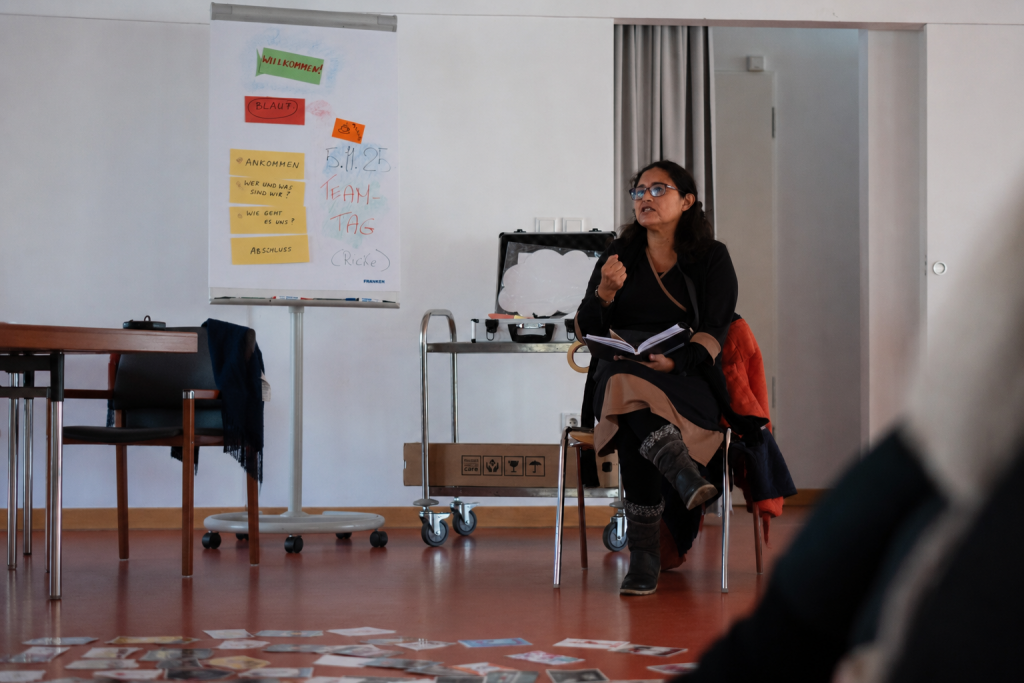
After becoming a mother in 2008, Marita founded MaMis en Movimiento (“Mothers in Motion”), an initiative supporting multilingual families and mothers with migration backgrounds in Berlin. What began as a grassroots movement evolved into a registered association in 2011.
Over the following four years, she mobilized local resources across Berlin’s districts and helped establish 15 community-based MaMis groups. Through this work, she witnessed the transformative potential of self-organized migrant networks, multilingual community engagement, and intercultural solidarity.
Inspired by the success of this grassroots model and its connections across diverse communities, languages, and cultures, she took the next step by co-creating migraMove in partnership with moveGLOBAL e.V. in 2015. Conceived as a tandem project, it aimed to strengthen migrant organizations, promote civic participation, and support community leadership in the district of Pankow, where she still lives today.
Within a year, the initiative had evolved into a professional networking and capacity-building project, expanding opportunities for migrant associations to engage with local institutions and participate more actively in public life. In 2017, the project was renamed migrapower and continued in cooperation with VIA e.V. In July 2022, it was relaunched as migra UP! hosted by Sources d’Espoir e.V.
Over the course of eleven years, the project became a recognized example of good practice in migrant participation and local governance, fostering sustainable partnerships between migrant organizations and public administrations. One notable achievement was the establishment of bilingual and multilingual storytelling events during the Berlin Fairy Tale Days, which are now funded by the district libraries.
Throughout these years, multilingualism remained a central pillar of Marita’s political and social engagement. She consistently advocated for linguistic diversity not merely as a cultural asset, but as a prerequisite for democratic participation, social inclusion, and equal opportunities in an increasingly diverse society.
Decolonizing Knowledge and Dialogue
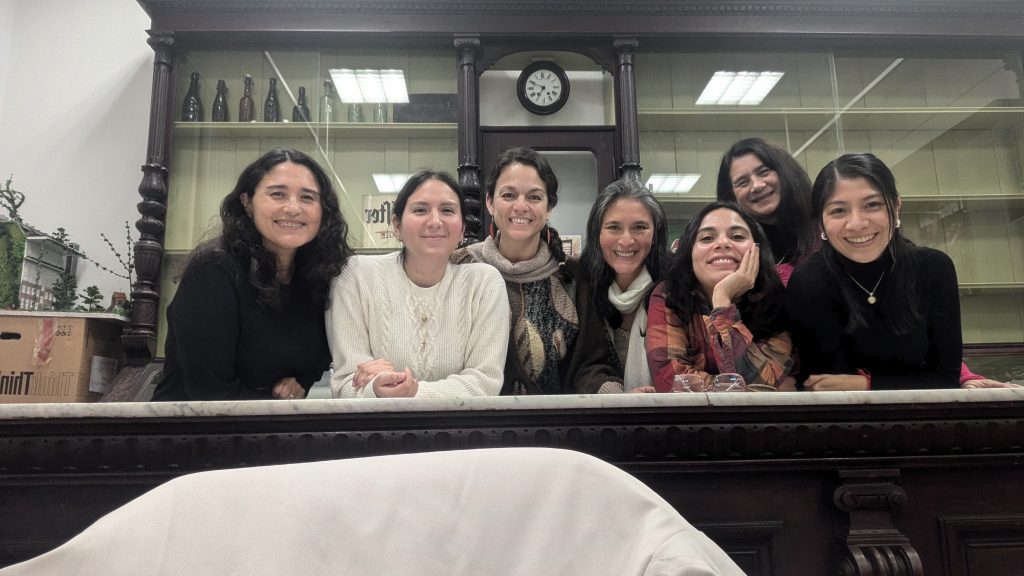
Her most recent initiative is MigrArte Perú e.V., an association and platform dedicated to fostering intercultural dialogue and bringing in decolonial and ecofeminist perspectives. “We want to create spaces where alternative worldviews and ways of knowing can be shared and recognized, while challenging Eurocentric and colonial assumptions,” she explains.
One of the association’s central goals is to create opportunities for mutual learning between the Global North and the Global South. “We ourselves have learned through these encounters,” Orbegoso Alvarez says. “Many of us grew up and were educated in postcolonial contexts that rarely encouraged critical reflection on the lasting effects of colonialism. Engaging with other perspectives has challenged us to rethink many assumptions and recognize forms of knowledge that are often overlooked,” she adds.
Although many members have academic backgrounds, they place equal value on other ways of knowing and learning. “We want to bring attention to the knowledge, skills, and life experiences of people whose expertise has not been shaped by formal academic pathways and who are too often undervalued or dismissed. There are forms of wisdom that do not depend on diplomas or years spent at universities.”
Another important focus of the association is ecological and decolonial education through art. One of MigrArte Perú e.V.’s recent initiatives has been the development of the concept of “decolonial crafts” (manualidades decoloniales), the result of several years of exchange with the Peruvian group Trenzando Fuerzas and the collective self-education among its members.
Through this process, the association has become increasingly engaged with Indigenous philosophies of nature and community-based ecological practices. Today, they share these perspectives through workshops and educational activities in schools, community centers, libraries, and cultural institutions, particularly around the district of Pankow. Their aim is to encourage more sustainable relationships with nature while creating spaces for reflection on the diverse knowledge systems that can contribute to ecological and social transformation.
Currently, the association is seeking donations to invite artists, spiritual leaders, and educators from the Amazon region to share their cultural heritage and Indigenous expertise.
Whether working with Indigenous women in Peru, protecting agricultural communities from mining projects, or creating spaces for intercultural dialogue in Berlin, Orbegoso Alvarez has consistently challenged the idea that there is only one way of understanding the world. “The fact that we were socialized with certain beliefs doesn’t mean there can’t be other truths out there. Our main message is that openness is key,” explains Marita Orbegoso Alvarez.