

“We Can’t Let Protection Become a Privilege”

Michaela Vas,

Vicky Germain
Representing over 90 organizations, the Migrationsrat e.V. (Migration Council Berlin) works at the intersection of policy, community empowerment, and rights advocacy. In this interview, project manager Vicky Germain explains why racialized migrants from Ukraine still face exclusion, how shrinking funding threatens essential support structures, and why solidarity must be practiced — not merely proclaimed.

WahlheYmatPost: Can you briefly introduce your organization? What is its main mission in Berlin?

Vicky Germain: The Migrationsrat Berlin e.V. (Migration Council Berlin) is an umbrella organization of more than 90 BIPoC (Black, Indigenous, and People of Color) and/or migrant self-organizations and post-migrant groups in Berlin. Its central mission is to improve the social, political, and legal situation of migrants living in Berlin – regardless of nationality, religion, age, social status, disability, gender, sexual orientation, or educational background. We are working towards a good, just and dignified life for everyone who lives in Berlin.

Our work focuses on political advocacy, community empowerment, critical policy and legislative analysis, and building concrete support structures for people who are frequently excluded from existing protection and participation systems. 

My main responsibility within this work is political and practical advocacy for BIPoC migrants from Ukraine and their families. This includes individual case counseling and support, as well as monitoring and critically assessing how the EU Temporary Protection Directive (EU 2001/55/EC) is interpreted and implemented in Germany. I work to ensure that racialized migrants are not excluded from protection mechanisms that are meant to apply universally.

WHP: What personally motivated you to get involved?

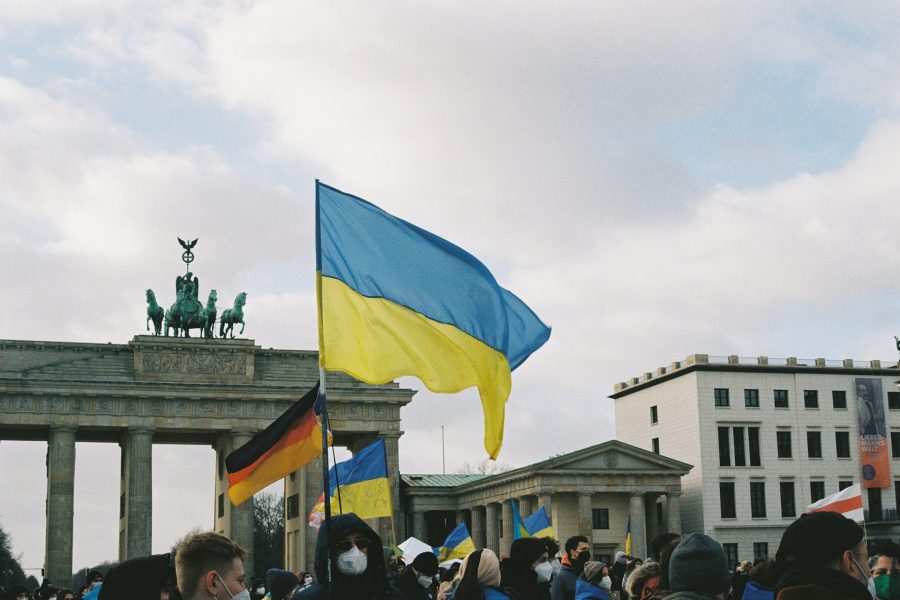
Vicky Germain: When the war began, I originally planned to volunteer at Berlin Central Station for no more than five weeks. As a Black third-country national, I was deeply shaken by the treatment of Black non-Ukrainian third-country nationals who were trying to flee the Russian invasion of Ukraine. Based on my own experiences as a Black migrant in Berlin, I could anticipate how their reception here would unfold — and I felt compelled to intervene. 

It soon became clear that my experience and skills as a coordinator in emergency relief could be helpful. At the same time, it became evident that the extraordinary, spontaneous support from people across different walks of life — as impactful as it was — needed stronger coordination and structure to be sustainable in the long term. 

Five weeks became nearly four years. What began as emergency assistance developed into a medium-term and eventually long-term commitment in the context of displacement, bureaucracy, exclusion, and structural racism. It was an extraordinary opportunity not only to support people upon arrival but also to accompany them throughout their settlement and new beginnings in Germany.

In many ways, I am now providing the kind of support I wish I had received when I first arrived in this country. It is empowering — not only to advocate for migrants like myself, but also to see directly how this advocacy and care work improves people’s real, everyday lives.

WHP: What challenges do people with a migration background face in Berlin — and how does your organization address them?

Vicky Germain: People with migration histories in Berlin face a wide range of structural and everyday challenges. These include discrimination in the housing and labor markets, limited access to adequate healthcare and psychosocial support, language barriers, complex and often arbitrary bureaucratic procedures, as well as growing societal hostility fueled by right-wing political narratives.

For many, insecurity about residence status, work permits, and family reunification results in constant instability. Racialized migrants are particularly affected by heightened surveillance, exclusion from protection systems, and restricted access to integration services.

The Migrationsrat Berlin responds to these challenges through a multi-layered approach: we provide individual case counseling, legal and bureaucratic orientation, political education, and community support. At the same time, we conduct structural advocacy and work with institutions to ensure that systemic discrimination is recognized and addressed. We strengthen migrant self-organization, bring migrant voices into political processes, and build alliances — with the aim that migrants are not merely “integrated” but actively participate in shaping the society they live in.

WHP: Do you have a project, event, or initiative coming up that you would recommend to our readers?

Vicky Germain: As part of the Communities First project, a new podcast series has recently been launched that highlights the experiences of non-Ukrainian third-country nationals who fled from Ukraine to Germany — told from their own perspectives. The stories are direct, personal, at times humorous, painful, and deeply thought-provoking.

The series encourages listeners to question dominant narratives of “welcoming culture” and invites reflection on humanity, solidarity, racism, and belonging in times of crisis and politically controlled migration.

The podcast can be found on YouTube at @cusbu.
Listen. Like. Subscribe. But above all — reflect.

WHP: How can interested people support your work or get involved themselves?

Vicky Germain: We are grateful to have been able to continue this work for almost four years now. Without the financial support of the Berlin Senate, CUSBU: CommUnities Support for BIPoC Refugees from Ukraine would not have been possible. The CommUnities First project also allowed two displaced persons from Ukraine to implement an empowerment project in Berlin Mitte – supported by the Integration Fund Mitte.

However, funding for diversity, equity, and inclusion is currently shrinking — and we are also affected by these cuts. Without new financial support, we will have to end our small but essential projects on 31 December 2025.

The most direct form of support is to donate to the Migrationsrat Berlin as well as organizations and projects that work for diversity, justice, inclusion, and migrant rights.

If financial support is not possible, there are still meaningful ways to act in solidarity: write to your elected representatives. Tag political decision-makers on Instagram, LinkedIn, X, Threads, or Facebook. Draw attention to projects like ours and demand that they continue.

We need less suffering on the streets of this city. The Migrationsrat Berlin and its partner organizations work every day to reduce this suffering — through projects such as CUSBU, CommUnities First, i-PÄD, ComE-In, Härtefallberatung (hardship case counseling), and many others.

Solidarity is an action — and every action counts.

Author:

More From WahlheYmatPost

  • From Peru to Berlin: Building Bridges Between Different Ways of Knowing 

    From Peru to Berlin: Building Bridges Between Different Ways of Knowing 

    Are degrees really the only measure of knowledge? Should humans focus on altering nature or adapting to it? Do international studies actually include perspectives from all around the world? Academic credentials, adapting nature to suit modern lifestyles and Eurocentric education are standards that are rarely questioned.  Marita Orbegoso Alvarez, Peruvian educator, community organizer and activist,…

  • Berlin Wiki: The Overlooked Election — BVV and Local Democratic Participation

    Berlin Wiki: The Overlooked Election — BVV and Local Democratic Participation

    How Does the BVV Election Work? On September 20, Berlin goes to the polls. On that day, the election to the House of Representatives (Abgeordnetenhaus) will take place, along with the elections to the District Council Assemblies (Bezirksverordnetenversammlungen, BVV). Berlin is divided into twelve districts, each of which elects its own District Council Assembly. This…

  • Finding Trauma Instead of Belonging: A Review of I Keep My Shadow Light 

    Finding Trauma Instead of Belonging: A Review of I Keep My Shadow Light 

    TL;DR “I Keep My Shadow Light” is the self-published debut novel by Fionnuala Kavanagh. This challenging work follows a cast of four characters from different backgrounds as they try to find a home in Berlin. Very dark in places, the book gives us a chance to read something that would probably never come out of…

  • Migrants With Degrees Are Not What Germany Is Looking For

    Migrants With Degrees Are Not What Germany Is Looking For

    Education is a right, not a privilege. This idea has been a founding principle of modern democracies. In practice, however, access to education is far from guaranteed for everyone. As of this year, Germany has significantly restricted access to state-funded intermediate and advanced German courses for migrants participating voluntarily. Many rejected asylum seekers, people with…

  • Berlin Wiki: Who Makes Decisions in the Districts?

    Berlin Wiki: Who Makes Decisions in the Districts?

    What Does a District Office Do? A Berlin district office (Bezirksamt) manages the administration of one of Berlin’s twelve districts and serves as the district’s political leadership. It consists of the district mayor and five district councillors (Bezirksstadträte), who are elected by the district assembly (Bezirksverordnetenversammlung, BVV). The district office implements adopted laws and policies.…

  • Berlin Wiki: How Berlin’s Government Works 

    Berlin Wiki: How Berlin’s Government Works 

    What Makes Berlin’s Governing Mayor Special? Whoever holds the office of Governing Mayor is both the head of government and the ceremonial head of the city of Berlin. The House of Representatives (Abgeordnetenhaus) votes on who will hold the position. There has even been a case in which someone won the election without being their…

  • Berlin Wiki: How Do the First and Second Vote Work? 

    Berlin Wiki: How Do the First and Second Vote Work? 

    What Does the First Vote Decide? The article looks at how voters elect candidates and parties in Bundestag elections and elections to the Berlin House of Representatives, and how seats in parliament are distributed through proportional representation. In Bundestag elections or elections to the House of Representatives, voters cast both a first vote and a…

  • Tempelhofer Feld: Berlin’s Most Emotional Urban Conflict Is Back 

    Tempelhofer Feld: Berlin’s Most Emotional Urban Conflict Is Back 

    We are approaching an election in September. Hopefully, you’re reading along in the Berlin Wiki to bone up on how stuff works in German elections, the lexicon, and the issues. Well, one of the issues we’re going to see debated concerns the Tempelhofer Feld. So let’s talk about that for a bit.  The other night,…

  • Berlin Wiki: Parties, Direct Mandates and the Five-Percent Threshold 

    Berlin Wiki: Parties, Direct Mandates and the Five-Percent Threshold 

    What Is a Political Party? A political party is an association of citizens regulated by the German Federal Party Law. Political parties aim to influence political decision-making at federal or state level over a longer period of time and may represent voters in state parliaments or in the Bundestag. First of all, a party needs…

  • Good Intentions Are Not Democratic Enough

    Good Intentions Are Not Democratic Enough

    “What you do for me, but without me, you do against me” — the exact origin of this quote is unclear. Nevertheless, it captures something that frequently happens in Germany when it comes to the political participation of historically excluded groups. Policies are supposedly made for migrants, yet not with them. Gender equality is debated…

  • What Happened When I Tried to Organize My Neighbors 

    What Happened When I Tried to Organize My Neighbors 

    There’s a lot of talk today about building community. At our March WahlheYmat Talk, the crowd brought up the subject, specifically that we should be creating more of it. Ideas flew around the room. We are living in an era of schism, where the people pulling the levers of power are trying to create an…

  • Berlin Wiki: Who Is Allowed to Vote – and Why Not Everyone Can

    Berlin Wiki: Who Is Allowed to Vote – and Why Not Everyone Can

    Who is allowed to vote, and who is not? In a democratic state like Germany, the right to vote is of central importance. It allows citizens to take part in political decision-making and help determine the composition of the government. In Germany, voters must meet certain requirements in order to vote. They must hold German…

  • Berlin Wiki: Party Profiles II – The Greens, The Left, the AfD and the BSW party

    Berlin Wiki: Party Profiles II – The Greens, The Left, the AfD and the BSW party

    What is the Green Party? Bündnis 90/Die Grünen is an important political force in the Berlin House of Representatives. Although the party has not been part of the government since the 2023 election, it operates from the opposition within parliament. Its guiding principle is ecological, economic, and social sustainability. It focuses on stronger climate protection,…

  • Berlin Wiki: Party Profiles I — Which Parties Shape the Capital?

    Berlin Wiki: Party Profiles I — Which Parties Shape the Capital?

    Which parties are important in Berlin? Berlin has many political parties, each pursuing its own agenda. These parties are organized at different levels. Many have a Berlin state association, as well as several district and local branches. The parties that receive the most votes form parliamentary groups in the House of Representatives, Berlin’s parliament. The…

  • The Good, the Bad, and the Arbeitsamt

    The Good, the Bad, and the Arbeitsamt

      Most places have an arm of the government to help folks out when they’re unemployed; governments like their citizens to have jobs and pay taxes. It tends to keep the governments – and the citizens – happy. There’s also the matter of not letting people starve in the street when they’re out of work.…

Address

Am Hamburger Bahnhof 3
10557 Berlin
Germany

hey@wahlheymat.de

Social Networks