
Six Pictures from the Future — A Glimpse into Tomorrow’s Berlin

Ivan Gabor,

Berlin Future
This week marks the launch of the WahlheYmatPost campaign — and we want to give you an insider’s look behind the scenes. We hope you’ll convince everyone around you to subscribe to WahlheYmatPost!

For a campaign, you need many elements — but everything starts with funding. That’s why we first want to give enormous thanks to the supporters of WahlheYmatPost, to everyone who believes in what we do and why we do it: the Welcome Alliance Fund by ProjectTogether and the Bundesministerium des Inneren. And a heartfelt thank-you to our cooperation partner, Berliner Morgenpost.

We worked on the creative development for almost seven weeks. “Creative work” always sounds elegant and glamorous — and yes, it is fun. But the recipe for success always has two ingredients:

  1. A crystal-clear understanding of what you want to communicate
    (in our case: WahlheYmatPost)
  2. A strong, talented creative team

And we truly had one:


Bence Bodnar (Creative Director),
Lillian Dam Bracia (Producer & Project Manager),
Luise Spielhagen (Illustration & Design),
Eduardo Marin (Animation).


A real supergroup of Berlin-based creatives.

For the first point — understanding why this matters — we had many ideas on the table, but none felt sharp enough.
Why is access to information about social participation so important?
Why do international Berliners need to be active in social and political life?
What will their participation actually change?
How does an ideal future look — a future with an active international society?
And how can we make such a society tangible, imaginable?

So we decided to create something simple and powerful: a snapshot of Berlin in 2035.

We imagined holding a camera (or a drone) above the city and capturing what Berlin’s future community life could look like. We created six crystal-clear pictures from the future.

Here they are — described for you:

1. The Long Kiez Table

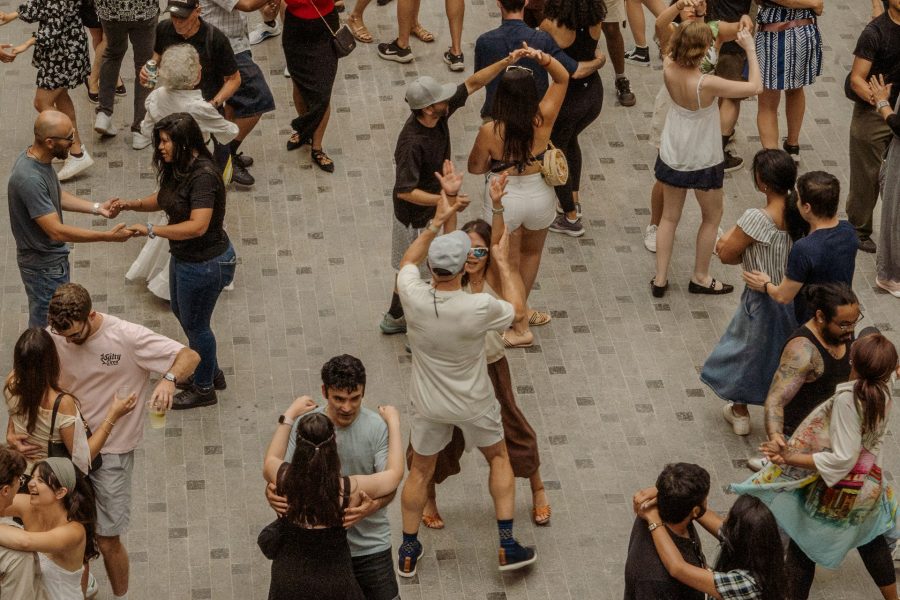
A hundred-meter-long Kiez table winds through the streets — every Kiez has its own version of it. It’s the weekend. People bring their tables, food, and drinks. It feels like a ritual. Everyone knows each other. The tables merge into one long, joyful snake. People share food, share stories, share their week. And then, as naturally as breathing, the gathering becomes a kind of assembly: residents discuss Kiez issues, vote on decisions, use their devices — a living, breathing Kiez democracy. A kind of United Kiezes of Berlin.

2. The Community Rooftop Gardens

Berlin’s rooftops are greener than ever. We see connected gardens stretching across neighbourhoods. Berliners from all over the world gardening together. Kids are playing. Parents and grandparents (and even great-grandparents) chat. It’s clear: this isn’t their first time — this is a living community tradition.

Community Garden

3. A Grandmother Teaches at School

We see a classroom full of diverse children. A grandmother shares her life story — how her perspective has changed over the years. Talking to the kids, we realise this is completely normal here: not only teachers but parents, grandparents, neighbours from all walks of life regularly join the school day, sharing knowledge, skills, craft, sports — turning school into a center of life-learning.

4. The Bike Repair Station Under the S-Bahn Arch

We stop at a friendly bike repair shop. But this wasn’t always a shop — back in 2025 it was an abandoned place near Hauptbahnhof. Now it’s a container workshop run by volunteers from the Kiez. Each person works a few hours a month. People pay a small contribution to maintain the space. We walk away — and suddenly the picture widens: an entire row of community-run containers appears — sports spaces, mini-parks, cafés, workshops, food stands, and yes, plenty of huge trash bins.

5. The Community House

We see an apartment complex organised as a multigenerational home. Elderly people receive care and also act as grandparents to the community. People share breakfasts and dinners, mixing privacy with shared spaces. It combines ultramodern living standards with ancient forms of togetherness — a way of living built on trust, reliability, and community.

6. The HeYmatHaus

It used to be… well, something else. Not important anymore. Now it is the central meeting place of Berlin’s international society. A home for film, theatre, music — performed by amateurs or professionals, by children or grandparents. A place where traditions are preserved, shared, transformed — where new art forms emerge through the mix of cultures. A house that belongs to everyone.

A Berlin where we live in an international, collaborative, inclusive society. A democracy built on local communities, funded partly by public money, and shaped by the decisions of the people themselves. This society is the foundation for creativity, innovation, and the strength to face the challenges ahead.

These are our pictures of the future. We hope you like them.

We know they can become reality — and we know how.

The next chapter begins simply: by subscribing to and reading WahlheYmatPost.

If enough of us join, we can build this new world step by step —

turning readers into a community,
turning ideas into energy,
turning open minds into open hearts.

We believe in this future – and hope you will join us in building it.
Author:

More From WahlheYmatPost

  • Berlin Wiki: How Berlin’s Government Works 

    Berlin Wiki: How Berlin’s Government Works 

    What Makes Berlin’s Governing Mayor Special? Whoever holds the office of Governing Mayor is both the head of government and the ceremonial head of the city of Berlin. The House of Representatives (Abgeordnetenhaus) votes on who will hold the position. There has even been a case in which someone won the election without being their…

  • Migrants With Degrees Are Not What Germany Is Looking For

    Migrants With Degrees Are Not What Germany Is Looking For

    Education is a right, not a privilege. This idea has been a founding principle of modern democracies. In practice, however, access to education is far from guaranteed for everyone. As of this year, Germany has significantly restricted access to state-funded intermediate and advanced German courses for migrants participating voluntarily. Many rejected asylum seekers, people with…

  • Berlin Wiki: How Do the First and Second Vote Work? 

    Berlin Wiki: How Do the First and Second Vote Work? 

    What Does the First Vote Decide? The article looks at how voters elect candidates and parties in Bundestag elections and elections to the Berlin House of Representatives, and how seats in parliament are distributed through proportional representation. In Bundestag elections or elections to the House of Representatives, voters cast both a first vote and a…

  • Tempelhofer Feld: Berlin’s Most Emotional Urban Conflict Is Back 

    Tempelhofer Feld: Berlin’s Most Emotional Urban Conflict Is Back 

    We are approaching an election in September. Hopefully, you’re reading along in the Berlin Wiki to bone up on how stuff works in German elections, the lexicon, and the issues. Well, one of the issues we’re going to see debated concerns the Tempelhofer Feld. So let’s talk about that for a bit.  The other night,…

  • Berlin Wiki: Parties, Direct Mandates and the Five-Percent Threshold 

    Berlin Wiki: Parties, Direct Mandates and the Five-Percent Threshold 

    What Is a Political Party? A political party is an association of citizens regulated by the German Federal Party Law. Political parties aim to influence political decision-making at federal or state level over a longer period of time and may represent voters in state parliaments or in the Bundestag. First of all, a party needs…

  • Good Intentions Are Not Democratic Enough

    Good Intentions Are Not Democratic Enough

    “What you do for me, but without me, you do against me” — the exact origin of this quote is unclear. Nevertheless, it captures something that frequently happens in Germany when it comes to the political participation of historically excluded groups. Policies are supposedly made for migrants, yet not with them. Gender equality is debated…

  • What Happened When I Tried to Organize My Neighbors 

    What Happened When I Tried to Organize My Neighbors 

    There’s a lot of talk today about building community. At our March WahlheYmat Talk, the crowd brought up the subject, specifically that we should be creating more of it. Ideas flew around the room. We are living in an era of schism, where the people pulling the levers of power are trying to create an…

  • Home Is Not a Place: A Berlin Exhibition Rethinks Migration

    Home Is Not a Place: A Berlin Exhibition Rethinks Migration

    How do people change after moving from one place to another? What do they leave behind and what do they carry with them? Is it possible to feel at home in a space that is vastly different from the one we left? In her latest installation “Remembering Space (how much past can the present hold)”,…

  • Berlin Wiki: Who Is Allowed to Vote – and Why Not Everyone Can

    Berlin Wiki: Who Is Allowed to Vote – and Why Not Everyone Can

    Who is allowed to vote, and who is not? In a democratic state like Germany, the right to vote is of central importance. It allows citizens to take part in political decision-making and help determine the composition of the government. In Germany, voters must meet certain requirements in order to vote. They must hold German…

  • Berlin Wiki: Party Profiles II – The Greens, The Left, the AfD and the BSW party

    Berlin Wiki: Party Profiles II – The Greens, The Left, the AfD and the BSW party

    What is the Green Party? Bündnis 90/Die Grünen is an important political force in the Berlin House of Representatives. Although the party has not been part of the government since the 2023 election, it operates from the opposition within parliament. Its guiding principle is ecological, economic, and social sustainability. It focuses on stronger climate protection,…

  • Berlin Wiki: Party Profiles I — Which Parties Shape the Capital?

    Berlin Wiki: Party Profiles I — Which Parties Shape the Capital?

    Which parties are important in Berlin? Berlin has many political parties, each pursuing its own agenda. These parties are organized at different levels. Many have a Berlin state association, as well as several district and local branches. The parties that receive the most votes form parliamentary groups in the House of Representatives, Berlin’s parliament. The…

  • The Good, the Bad, and the Arbeitsamt

    The Good, the Bad, and the Arbeitsamt

      Most places have an arm of the government to help folks out when they’re unemployed; governments like their citizens to have jobs and pay taxes. It tends to keep the governments – and the citizens – happy. There’s also the matter of not letting people starve in the street when they’re out of work.…

  • Berlin Wiki: Your Guide to the 2026 Berlin Election

    Berlin Wiki: Your Guide to the 2026 Berlin Election

    What will be elected in Berlin in 2026? On September 20, 2026, a new House of Representatives will be elected in Berlin. At the same time, the district assemblies of Berlin’s twelve districts will also be elected. The electoral term is always five years. Voters therefore decide which parties and politicians will serve in these…

  • “Das Volk” in 2026: Time to Redefine the People

    “Das Volk” in 2026: Time to Redefine the People

    “Do you behave as the person you truly want to be?” I ask myself this question in moments when I clearly fall short. Yes, it is hard to live up to one’s ideal self—I’m probably not the only one who feels this way. The same applies for societies. Over the past ten years, I have…

  • “Treat Every Case as Your Own”: How Zaki e.V. Supports Berlin’s Overlooked Migrants

    “Treat Every Case as Your Own”: How Zaki e.V. Supports Berlin’s Overlooked Migrants

    WHP: Can you briefly introduce Zaki e.V.? What is your main mission in Berlin? Pia Bergmann: Zaki – Bildung und Kultur e.V. is a migrant-led organization, with its main office located at the Berlin Global Village in Neukölln and another office in Pankow. The organization’s focus can be summed up in one sentence: arrival and…

Address

Am Hamburger Bahnhof 3
10557 Berlin
Germany

hey@wahlheymat.de

Social Networks