
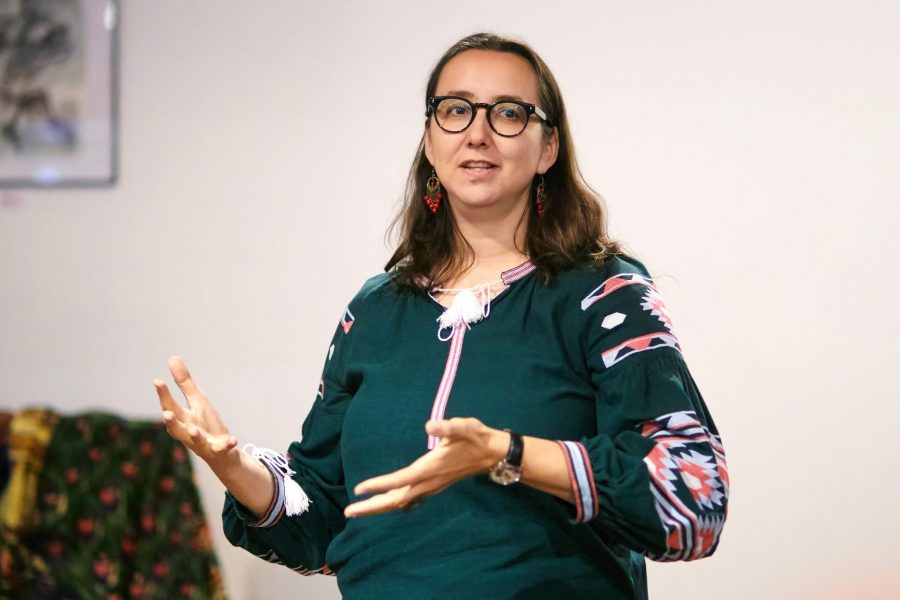
Ukrainian Voices in Berlin: “People Are Not Objects for Integration Debates”

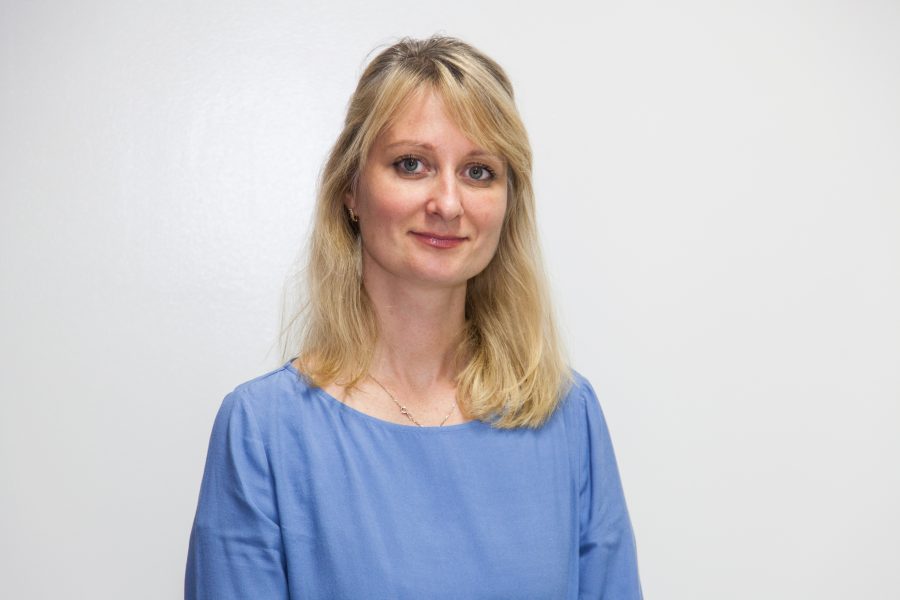
Migration is often discussed in terms of labor, integration, and bureaucracy – but rarely as a question of rights, voice, and political participation. Oleksandra Bienert, chairwoman of the Allianz Ukrainischer Organisationen, speaks about fighting disinformation, confronting structural discrimination, and why migrant communities must be recognized as active political actors rather than the objects of integration debates. 

WHP: Can you briefly introduce the Allianz Ukrainischer Organisationen e.V (Alliance of Ukrainian Organizations)? What is its main task in Berlin?

Oleksandra Bienert: The Allianz Ukrainischer Organisationen e.V. is a nationwide association currently bringing together 23 civil society organizations in eight federal states. These organizations were founded by people with a Ukrainian migration background and work predominantly on a voluntary basis.

Our member organizations are engaged in the fields of political participation, human rights, refugee support, education, youth and cultural work, labor market integration, and anti-discrimination. In Berlin, we are represented, among others, in the State Advisory Council for Participation and in several integration advisory boards. An important area of our work is also the fight against disinformation. Especially in the context of Russia’s war of aggression against Ukraine, we observe targeted narratives that seek to delegitimize Ukraine or to pit migrant communities against each other. We counter this through awareness-raising, political education, and networking.

Our central task is to support equal social and political participation for people from Ukraine – and beyond that for all people with a migration background. We advocate for an open, democratic society and clearly position ourselves against racism, antisemitism, racism against Sinti and Roma, homophobia and transphobia, as well as any form of group-based hostility.

At the same time, we want to make Ukraine more visible as a free European subject – beyond imperial narratives or stereotypical attributions.

WHP: What personally motivated you to get involved here?

Oleksandra Bienert: What motivates me is a deep-rooted sense of justice. My grandfather was a trade unionist in Ukraine, and parts of my family were deported to the Gulag under the Soviet regime on fabricated accusations – others were executed. This history has shaped me: when you recognize injustice, you must not remain silent.

When I came to Germany, I also experienced how strongly the image of Ukraine was shaped by anti-Eastern European racism and a Russian imperial perspective. I want to contribute to changing this perspective – or, if you will, to decolonizing it.

For me, my engagement is an attempt to create spaces in which people are not treated as objects of integration debates, but as active subjects with their own voices.

WHP: What challenges do people with a migration background face in Berlin – and how does your organization address them?

Oleksandra Bienert: One of the central challenges is that migration is often politically reduced to an economic issue. People are primarily viewed as “labor” or “human resources” – not as bearers of rights, biographies, and dignity. Integration is often linked to economic usefulness.

At the same time, many refugees experience structural barriers: racism, difficulties in having qualifications recognized, insecurity due to temporary residence permits, bureaucratic obstacles and a lack of multilingual information, cuts to or absence of anti-discrimination counseling, including counseling in Ukrainian. Particularly affected are vulnerable groups – including people with disabilities, seniors, Roma from Ukraine, queer refugees, Black people and other people of color, people living with HIV, as well as war-injured individuals – who are often exposed to multiple forms of discrimination.

Another central challenge is access to language – and thus to participation. Our practical experiences with integration and vocational language courses clearly show that access to language courses is not a technical question, but a matter of social justice and dignity. Language competence means access to rights, healthcare, and political participation. Those who are structurally excluded from it remain dependent.

We respond on several levels: political advocacy at the state and federal level, statements and professional events, as well as support for building independent structures where public services are lacking.

Through our members such as Kwitne Queer e.V., which creates a safe space for queer refugees from Ukraine, or PlusUkrDe – Positive Ukrainians in Germany, which advocates for discrimination-free access to HIV care, we see how important it is for communities to organize themselves, create their own safe spaces, and develop strong networks in order to confidently claim their rights and dismantle structural barriers.

We understand participation as a right – not as a privilege.

WHP: Is there a project, event, or initiative coming up that you would particularly recommend to our readers?

Oleksandra Bienert: An exciting two-year community project has just begun under the title: “Writing Urban History: Ukrainian Perspectives in the Berlin Dialogue.”

The project is being implemented by our member CineMova Ukrainian Empowerment Network e.V. together with several partner organizations – including agitPolska e.V., Zwischen den Polen e.V., and the Alliance – and is funded by the Berlin Senate.

It invites people with Ukrainian or Polish roots in Berlin to explore historical traces of migration, Nazi forced labor, exile, flight, and resistance, and to make their own perspectives visible.

Planned activities include archive workshops, artistic activities, memorial site visits, biographical research, and a public exhibition. The goal is to permanently inscribe Ukrainian stories into Berlin’s culture of remembrance. Application period: March 3 – March 15, 2026. Click here for the application form.

At the same time, we are open to cooperation – particularly with migrant initiatives that work to strengthen the visibility of migrant perspectives in Berlin’s urban history, as well as with historical projects and educational actors.

WHP: How can interested people support your work or get involved themselves?

Oleksandra Bienert: Committed individuals are always welcome to join us – regardless of origin or community. At the moment, we are especially looking for volunteers, for example for language cafés for seniors, organizational support for events, or assistance with small community formats. In addition, people can support us occasionally – for example through translations, moderating workshops, providing professional input on specific topics, supporting social media work, or offering practical help during events. Sharing our information within personal networks or connecting us with schools, initiatives, or neighborhood projects is also very valuable to us. Engagement with us is flexible – from one-time contributions to longer-term involvement. Every form of participation counts.

In addition, cooperation with other communities is explicitly encouraged. We are convinced that solidarity between migrant and post-migrant initiatives is crucial for dismantling structural inequalities and strengthening sustainable participation.

Interested individuals can easily contact us by email.

Every form of support – whether occasional or long-term – contributes to working together toward a solidaristic, diverse, and human-rights-based urban society.

(Header image: © Dmitry Brushko)

Author:

More From WahlheYmatPost

  • Ukrainian Voices in Berlin: “People Are Not Objects for Integration Debates”

    Ukrainian Voices in Berlin: “People Are Not Objects for Integration Debates”

    WHP: Can you briefly introduce the Allianz Ukrainischer Organisationen e.V (Alliance of Ukrainian Organizations)? What is its main task in Berlin? Oleksandra Bienert: The Allianz Ukrainischer Organisationen e.V. is a nationwide association currently bringing together 23 civil society organizations in eight federal states. These organizations were founded by people with a Ukrainian migration background and…

  • WahlheYmat Turns Two — And Invites You In

    WahlheYmat Turns Two — And Invites You In

    WahlheYmat is looking for new members.That is the message I would like to write about today. Before my life in Berlin, I was never this direct. I am learning a lot here. And I don’t just mean the famous Berliner Schnauze — like going into a bakery and saying: “Good morning, so sorry for disturbing…

  • The Berlin Blueprint: Participation as the Ultimate Act of Self-Determination

    The Berlin Blueprint: Participation as the Ultimate Act of Self-Determination

    In the glossy catalogs of modern wellness, “self-help” is often sold as a retreat from the world: a private journey of healing through products and quiet contemplation. Berlin’s history, however, offers a more rugged, democratic alternative. In this city, wellbeing has never been found in isolation. It has been forged through participation. To be a…

  • No Permission, More Love: Building Your Vision in Berlin Like Nalan Sipar

    No Permission, More Love: Building Your Vision in Berlin Like Nalan Sipar

    When Nalan Sipar asked her boss at Deutsche Welle if she could create content in Turkish to help inform the German-Turkish community during the early days of the 2020 global pandemic in Berlin, the answer was no.  Her boss at the time told her that a state contract prevented the government-funded broadcaster from covering information…

  • “Discrimination is not an individual problem, but a structural one”

    “Discrimination is not an individual problem, but a structural one”

    WHP: Can you briefly introduce Yekmal? What is your main task in Berlin? Remziye Uykun: Yekmal e.V. is a migrant education, parent and community organisation based in Berlin that now operates nationwide, with locations in several federal states. Our main task is to strengthen multilingualism as a democratic resource, enable equal participation and structurally anchor…

  • Berlin’s Silent 25 Percent

    Berlin’s Silent 25 Percent

    “We are in a very tense situation with a record number of non-voters and a great distrust in society towards institutions, so it was the right time to convene this citizens’ assembly.” This quote does not come from Berlin — although the record number of non-voters is also the case here. It was said by…

  • Building Home in Berlin: The Inside-Out Approach with Katarina Stoltz

    Building Home in Berlin: The Inside-Out Approach with Katarina Stoltz

    Katarina Stoltz, originally from Sweden, spent her first months in Berlin crying over Prosecco on a friend’s balcony in Prenzlauer Berg. She’d left behind a thriving career as a Reuters photojournalist in Warsaw. Her work was published in the New York Times, capturing Poland’s entry into the European Union. She’d quit her job, sold her…

  • 35 Years of Integration Work: CLUB DIALOG and the Power of Community Networks

    35 Years of Integration Work: CLUB DIALOG and the Power of Community Networks

    WHP: Can you briefly introduce your initiative? What is its main task in Berlin? Dr. Natalia Roesler: CLUB DIALOG e.V. is a migrant organisation that was founded in Berlin in 1988 to stimulate social dialogue between Russian-speaking migrants and local Berliners, as well as to promote the integration of immigrants. Over the course of more…

  • Monsieur Ibrahim’s Magic in Kreuzberg: From Runaway to Community Maker

    Monsieur Ibrahim’s Magic in Kreuzberg: From Runaway to Community Maker

    I set out to conduct my first-ever interview for WahlheYmatPost on a grey and rainy Friday afternoon in Charlottenburg. The founder of WahlheYmat e.V., Ivan Gabor, mentioned meeting a man named Jaybo, a Frenchman living in the heart of Kreuzberg who is positively impacting his community. I happily took the opportunity to try out being…

  • From Hate Brands to Love Brands: A Different Vision for Democracy

    From Hate Brands to Love Brands: A Different Vision for Democracy

    “We need impactful love brands… that blend purpose, impact, innovation, and emotion.”This challenge was launched by the GICA Impact Network, founded and led by our amazing friend Alexander Sascha Wolf. Sure, Sascha is right — but using the term love brand made me think. What are the love brands of our democratic and political life?…

  • Nebenkostenabrechnung: The Reckoning No One Explains

    Nebenkostenabrechnung: The Reckoning No One Explains

    TL;DR If you’re in Germany, be ready for big costs at the end of the year. You should also always have a savings pool to deal with random, crazy, unexpected bills that might show up. They tend to do that as the year ends.   We just had another Christmas in Germany. And wasn’t it magical,…

  • Rising Ukrainian Engagement Powers Berlin’s Civic Scene

    Rising Ukrainian Engagement Powers Berlin’s Civic Scene

    WHP: Can you briefly introduce your initiative? What is its main mission in Berlin? Tetyana Lavuta: Svoji.de is an online platform that increases the visibility of Ukrainian civic initiatives in Berlin and Brandenburg and supports their networking with other migrant communities. The name evokes a sense of belonging and safety: the Ukrainian word “svoji” (written…

  • Newcomers Are Not a Problem to Solve: How SINGA Deutschland Builds Participation

    Newcomers Are Not a Problem to Solve: How SINGA Deutschland Builds Participation

    WHP: Could you briefly introduce SINGA Deutschland? What is its main mission in Berlin? Sen Zhan: SINGA Deutschland was founded in 2016 by a brilliant team of three co-founders — Luisa Seiler, Sima Gatea, and Vinzenz Himmighofen — as a humanitarian response at a moment when many newcomers were arriving in Germany. From the beginning,…

  • Papers, please! — How I Turned a 90-Day Visa into a Home in Berlin

    Papers, please! — How I Turned a 90-Day Visa into a Home in Berlin

    When you’re trying to set up your life in Berlin, visas are one of the first things you need to get in order. Unless you’re an EU citizen, you can’t live and work in Germany without one. Simple as that! But there are a whole bunch of different visa options. Should you try for the…

  • Berlin’s Rental Maze: What an American Learns When the Landlord Plays Games

    Berlin’s Rental Maze: What an American Learns When the Landlord Plays Games

    If you moved to Berlin from another European country, then you probably already know how many protections renters have here. My German friends hate it when I go on about how awful the US is – especially the low-level injustice and exploitative chicanery – but as a renter, you have essentially no rights in the…

Address

Am Hamburger Bahnhof 3
10557 Berlin
Germany

hey@wahlheymat.de

Social Networks