
“Berlin Modern” — Is This the Modern Berlin?

Ivan Gabor,

Berlin Modern
Berlin is building another cultural landmark — the vast and gleaming Berlin Modern. But as cranes rise over the Kulturforum, a deeper question emerges: what kind of spaces does our city truly need? Ivan Gabor reflects on Berlin’s obsession with museums and imagines something different — a living, shared house for the people, a HeymatHaus where belonging itself could be built.

Last weekend, I had the chance to see inside Berlin’s newest museum: Berlin Modern.
The visit made me think about how we imagine the future Berlin.

If you’ve walked near the Kulturforum, between the Neue Nationalgalerie and the Philharmonie, you’ve surely noticed that enormous construction site. That is where Berlin Modern is rising — a new museum of modern art, designed by Herzog & de Meuron.
Facts: over 10,000 m², an opening planned for 2029, and an estimated cost of around 570 million euros.
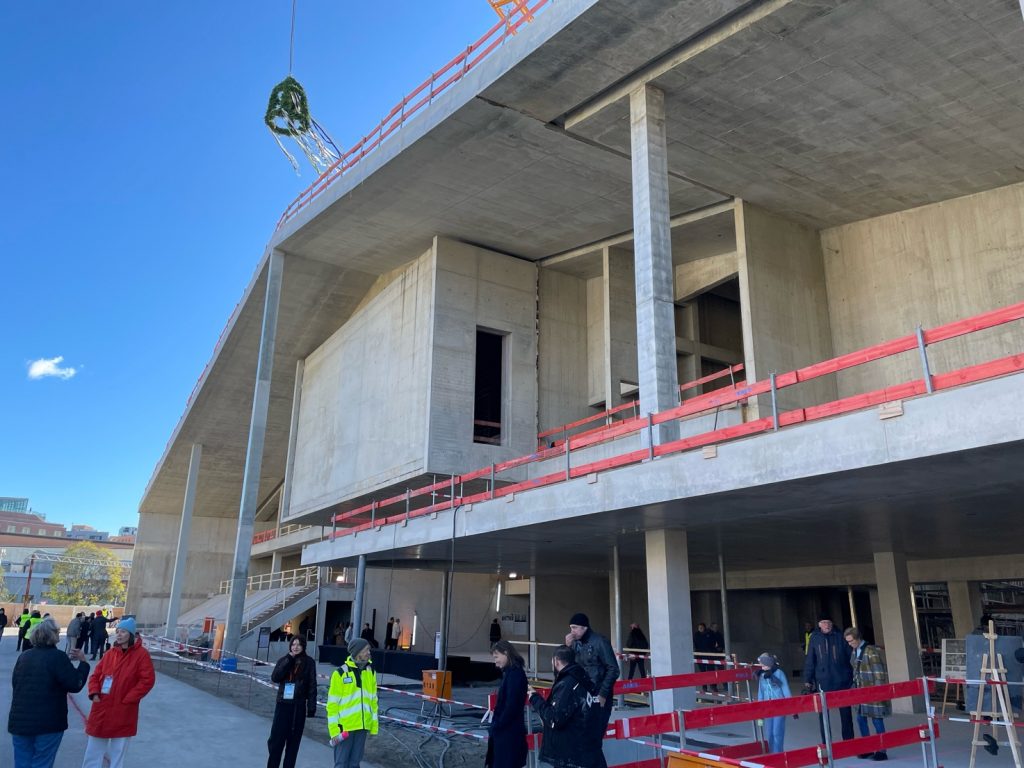
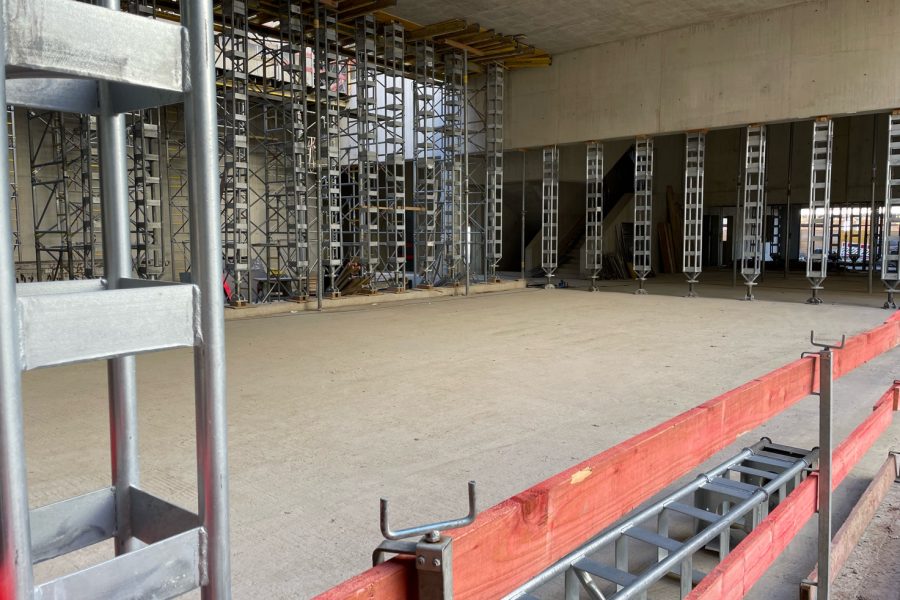
In Germany, when the skeleton of a building is finished, there’s a celebration — the Richtfest. It’s usually the first time the public can step inside. During this event, Berliners could buy a ticket for six euros and walk through the unfinished space: big, bright halls for art, cafés, and even plans for open public areas like a beer garden.

It is impressive — but as I walked through it, another building came to mind: Oodi, the Helsinki Central Library.


Oodi, completed in 2018, cost about 100 million euros and stands proudly in the very heart of Helsinki. It looks like a ship made of light and wood — transparent, warm, alive. But more importantly, it is not just a library. It’s a living house for the people.


Everyone can find what they need there: community, creativity, silence, play, food, inspiration. You can borrow musical instruments, record your own songs in professional studios, organize your own events, or simply read — there are more than 100,000 books.
It’s a place where culture and community meet naturally.

And I asked myself:
What kind of public spaces do we want in Berlin?

Berlin already built the Humboldt Forum — a monumental project that was meant to be an agora, a civic space for all. In reality, it became another museum.
Berlin invests enormous sums into cultural buildings — the Pergamon, the Neues Museum, the James-Simon-Galerie, and now the Berlin Modern.
We are, perhaps, a museum city.
But museums are not necessarily public spaces — not in the way Oodi is.

Years ago, we developed an idea called the HeymatHaus.


What if Berlin had a symbolic house — a place representing its society as it truly is: international, inclusive, collaborative?
A space where all cultures and communities in Berlin could live and share their traditions — where the whole world and all Bundesländer are equally at home.


A house where we could share food, show films, make music, exchange books, perform art, learn from one another. To design together a new way of living in an international community — to develop visions and co-create the path toward a Berlin that truly reflects its people.

Creating such a space would mean more than just building another institution — it would mean building belonging. 

About Berlin Modern

Berlin Modern (Museums- und Atelierhaus der Moderne) is a major new museum currently under construction at Berlin’s Kulturforum, designed by the renowned Swiss architects Herzog & de Meuron. The project aims to unite under one roof the modern art collections of the Nationalgalerie, the Kunstgewerbemuseum, the Kupferstichkabinett, and the Staatliche Museen zu Berlin’s Sammlung der 20er Jahre.

The building will offer around 10,000 square meters of exhibition space, with additional studios, workshops, and public areas. Construction began in 2021, and completion is planned for 2029. The total cost is estimated at around 570 million euros.

Situated between the Neue Nationalgalerie and the Berliner Philharmonie, Berlin Modern is envisioned as a central hub for 20th- and 21st-century art — and as a new architectural landmark in the city’s cultural landscape.

Author:

More From WahlheYmatPost

  • Berlin Wiki: How Berlin’s Government Works 

    Berlin Wiki: How Berlin’s Government Works 

    What Makes Berlin’s Governing Mayor Special? Whoever holds the office of Governing Mayor is both the head of government and the ceremonial head of the city of Berlin. The House of Representatives (Abgeordnetenhaus) votes on who will hold the position. There has even been a case in which someone won the election without being their…

  • Migrants With Degrees Are Not What Germany Is Looking For

    Migrants With Degrees Are Not What Germany Is Looking For

    Education is a right, not a privilege. This idea has been a founding principle of modern democracies. In practice, however, access to education is far from guaranteed for everyone. As of this year, Germany has significantly restricted access to state-funded intermediate and advanced German courses for migrants participating voluntarily. Many rejected asylum seekers, people with…

  • Berlin Wiki: How Do the First and Second Vote Work? 

    Berlin Wiki: How Do the First and Second Vote Work? 

    What Does the First Vote Decide? The article looks at how voters elect candidates and parties in Bundestag elections and elections to the Berlin House of Representatives, and how seats in parliament are distributed through proportional representation. In Bundestag elections or elections to the House of Representatives, voters cast both a first vote and a…

  • Tempelhofer Feld: Berlin’s Most Emotional Urban Conflict Is Back 

    Tempelhofer Feld: Berlin’s Most Emotional Urban Conflict Is Back 

    We are approaching an election in September. Hopefully, you’re reading along in the Berlin Wiki to bone up on how stuff works in German elections, the lexicon, and the issues. Well, one of the issues we’re going to see debated concerns the Tempelhofer Feld. So let’s talk about that for a bit.  The other night,…

  • Berlin Wiki: Parties, Direct Mandates and the Five-Percent Threshold 

    Berlin Wiki: Parties, Direct Mandates and the Five-Percent Threshold 

    What Is a Political Party? A political party is an association of citizens regulated by the German Federal Party Law. Political parties aim to influence political decision-making at federal or state level over a longer period of time and may represent voters in state parliaments or in the Bundestag. First of all, a party needs…

  • Good Intentions Are Not Democratic Enough

    Good Intentions Are Not Democratic Enough

    “What you do for me, but without me, you do against me” — the exact origin of this quote is unclear. Nevertheless, it captures something that frequently happens in Germany when it comes to the political participation of historically excluded groups. Policies are supposedly made for migrants, yet not with them. Gender equality is debated…

  • What Happened When I Tried to Organize My Neighbors 

    What Happened When I Tried to Organize My Neighbors 

    There’s a lot of talk today about building community. At our March WahlheYmat Talk, the crowd brought up the subject, specifically that we should be creating more of it. Ideas flew around the room. We are living in an era of schism, where the people pulling the levers of power are trying to create an…

  • Home Is Not a Place: A Berlin Exhibition Rethinks Migration

    Home Is Not a Place: A Berlin Exhibition Rethinks Migration

    How do people change after moving from one place to another? What do they leave behind and what do they carry with them? Is it possible to feel at home in a space that is vastly different from the one we left? In her latest installation “Remembering Space (how much past can the present hold)”,…

  • Berlin Wiki: Who Is Allowed to Vote – and Why Not Everyone Can

    Berlin Wiki: Who Is Allowed to Vote – and Why Not Everyone Can

    Who is allowed to vote, and who is not? In a democratic state like Germany, the right to vote is of central importance. It allows citizens to take part in political decision-making and help determine the composition of the government. In Germany, voters must meet certain requirements in order to vote. They must hold German…

  • Berlin Wiki: Party Profiles II – The Greens, The Left, the AfD and the BSW party

    Berlin Wiki: Party Profiles II – The Greens, The Left, the AfD and the BSW party

    What is the Green Party? Bündnis 90/Die Grünen is an important political force in the Berlin House of Representatives. Although the party has not been part of the government since the 2023 election, it operates from the opposition within parliament. Its guiding principle is ecological, economic, and social sustainability. It focuses on stronger climate protection,…

  • Berlin Wiki: Party Profiles I — Which Parties Shape the Capital?

    Berlin Wiki: Party Profiles I — Which Parties Shape the Capital?

    Which parties are important in Berlin? Berlin has many political parties, each pursuing its own agenda. These parties are organized at different levels. Many have a Berlin state association, as well as several district and local branches. The parties that receive the most votes form parliamentary groups in the House of Representatives, Berlin’s parliament. The…

  • The Good, the Bad, and the Arbeitsamt

    The Good, the Bad, and the Arbeitsamt

      Most places have an arm of the government to help folks out when they’re unemployed; governments like their citizens to have jobs and pay taxes. It tends to keep the governments – and the citizens – happy. There’s also the matter of not letting people starve in the street when they’re out of work.…

  • Berlin Wiki: Your Guide to the 2026 Berlin Election

    Berlin Wiki: Your Guide to the 2026 Berlin Election

    What will be elected in Berlin in 2026? On September 20, 2026, a new House of Representatives will be elected in Berlin. At the same time, the district assemblies of Berlin’s twelve districts will also be elected. The electoral term is always five years. Voters therefore decide which parties and politicians will serve in these…

  • “Das Volk” in 2026: Time to Redefine the People

    “Das Volk” in 2026: Time to Redefine the People

    “Do you behave as the person you truly want to be?” I ask myself this question in moments when I clearly fall short. Yes, it is hard to live up to one’s ideal self—I’m probably not the only one who feels this way. The same applies for societies. Over the past ten years, I have…

  • “Treat Every Case as Your Own”: How Zaki e.V. Supports Berlin’s Overlooked Migrants

    “Treat Every Case as Your Own”: How Zaki e.V. Supports Berlin’s Overlooked Migrants

    WHP: Can you briefly introduce Zaki e.V.? What is your main mission in Berlin? Pia Bergmann: Zaki – Bildung und Kultur e.V. is a migrant-led organization, with its main office located at the Berlin Global Village in Neukölln and another office in Pankow. The organization’s focus can be summed up in one sentence: arrival and…

Address

Am Hamburger Bahnhof 3
10557 Berlin
Germany

hey@wahlheymat.de

Social Networks