
WHP: Can you briefly introduce Zaki e.V.? What is your main mission in Berlin?
Pia Bergmann: Zaki – Bildung und Kultur e.V. is a migrant-led organization, with its main office located at the Berlin Global Village in Neukölln and another office in Pankow. The organization’s focus can be summed up in one sentence: arrival and inclusion through education.
Zaki (ذكي) comes from Arabic and is also used in Persian. It means something like smart or clever. A name that says it all—because at Zaki, the main goal is to support people from Afghanistan, Arab countries, and Ukraine in finding education and work in Germany. Or, in short: self-efficacy. The organization was founded in 2019 by Omed Arghandiwal, who himself has Afghan roots and is now the managing director of Zaki e.V. Based on the migration experiences of its staff, the organization sees itself as one that offers counseling and educational work—low-barrier, multilingual, and free of charge.
WHP: What personally motivated you to get involved there?
Pia Bergmann: After living in Palestine for seven years, I returned to my hometown of Berlin in 2023 and had to completely reorient myself. In a society where there is hardly any talk of a welcoming culture anymore and debates around migration are increasingly shaped by racist and apocalyptic views, it was clear to me: I wanted to find work that felt meaningful, where I could learn new things and feel comfortable.
And that is exactly what Zaki e.V. is for me. It may sound cheesy, but I enjoy going to work every day. Two years ago, I took over administration and public relations at Zaki e.V. Meanwhile, I also provide one-on-one coaching and exam preparation for young Afghans, as well as social counseling for Arabic-speaking people, which I greatly enjoy because I value direct contact and exchange.
In doing so, I do not only see my role as supportive, but also as learning: I take something new from every encounter. I am repeatedly impressed and inspired by what the people we work with here manage to achieve. And all within a system that often makes things very difficult for them.
WHP: What challenges do people with a migration background in Berlin face—and how does your organization respond to them?
Pia Bergmann: People come to us with a wide range of concerns and problems. Our target groups include people from Afghanistan, from Arabic-speaking countries, and so-called third-country nationals from Ukraine. These are people who, for example, lived in Ukraine for studies or work, then had to flee, and now cannot return either to Ukraine or to their countries of origin. These are often overlooked groups. And that is exactly where we see our mission.
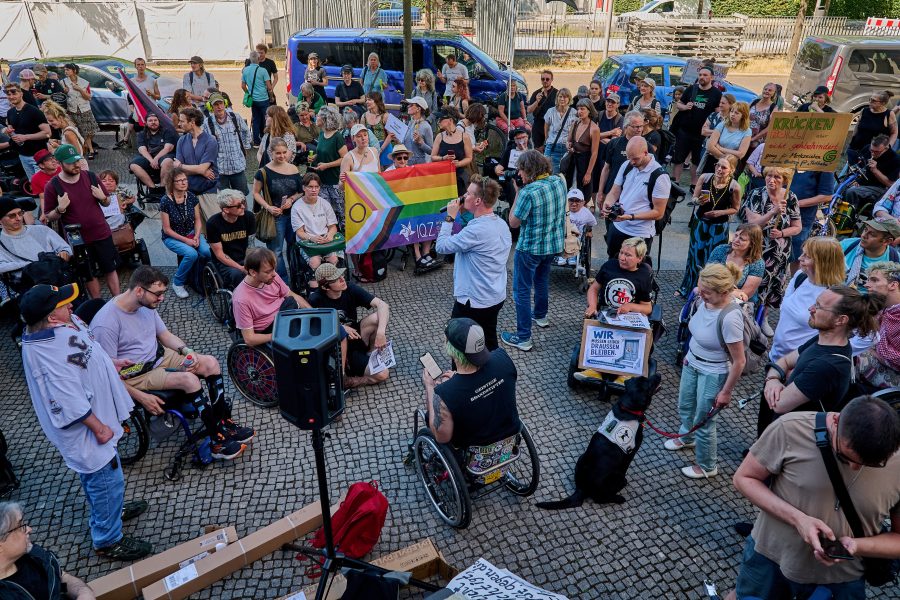
One of our projects supports people with disabilities from Afghanistan.
For example, last month in our social counseling, we succeeded in helping a chronically ill pensioner from Afghanistan assert her rights. For eight months, she had been passed back and forth between the health insurance company and the social welfare office—neither institution considered itself responsible. For her, this meant no secure health insurance and therefore no regular access to urgently needed blood pressure medication. Together, we finally filed a complaint with the police. Just one week later, things began to move—the health insurance has been reactivated and her medical care secured.
This is just one example of how people often get lost in the bureaucratic maze. The case shows how important it is to accompany those affected in deadlocked procedures and to clearly demand accountability. Our managing director always says: “Treat every problem as if it were your own.” Instead of sending people from A to B to C, we do everything we can to find a solution.
WHP: Is there a project, event, or initiative at Zaki e.V. coming up that you would especially recommend to our readers?
Pia Bergmann: As part of our projects for men in Pankow and Charlottenburg-Wilmersdorf, we regularly offer workshops on mental health. These are the next ones:
In Dari: 08.04.2026, 17:30–19:30 “Feelings and methods to cope with them (anger)” at our office in Pankow (Schönfließer Str. 7, 10439 Berlin)
In Arabic: 24.04.2026, 15:00–16:30 “Cultural identity, roots, new values” at Ulme 35 (Ulmenallee 35, 14050 Berlin)
As part of our project “Digital offers for Afghans in Berlin,” there are also regular info seminars for single parents and people with disabilities from Afghanistan, which can be attended both on-site at our office in Neukölln (Am Sudhaus 2, 12053 Berlin) and online. Information can be found on Instagram, Facebook, or in our event calendar.
WHP: How can interested people support your work or get involved themselves?
Pia Bergmann: For us, education is a fundamental human right. That is why we are committed to providing a wide range of educational opportunities, especially for people with migration and refugee backgrounds. As a non-profit organization, we rely on funding and donations. Therefore, we are very grateful for donations that help us maintain and further develop our work in the long term.In addition to financial support, voluntary engagement is also very welcome—every form of participation helps strengthen our work!
(Header image: © Max Schröder)